The small red square on a Japanese painting or print is a seal, the artist's personal mark stamped in red paste. In everyday Japanese life a name seal is called a hanko and is used in place of a signature on documents; in art, the same kind of seal signs, dates and sometimes comments on the work. It tells you who made the piece, and its placement is a deliberate part of the composition.
Once you know what to look for, the hanko seal becomes one of the most interesting details on a piece of Asian art. This guide covers where seals came from, how they are used in painting, how to read one, and why we put a seal on our own designs.
A brief history of the seal
Seals began in China, where carved stamps were used for thousands of years to authenticate official documents and goods. The practice reached Japan early. The oldest known seal found in Japan, a small gold stamp discovered on the island of Shikanoshima near Fukuoka in the eighteenth century, is believed to have been sent by a Chinese emperor to a local ruler in the first century.
For many centuries, seals in Japan were the property of officials, temples and the nobility. Over time they spread to merchants and then to ordinary households. Today most adults in Japan still own at least one, and the habit of stamping rather than signing remains common in banking, property and official paperwork, although it is slowly giving way to digital signatures.
Hanko, inkan and the different everyday seals
Hanko and inkan are both used for personal seals, and most people use the words interchangeably. A typical household might hold several: a registered seal for the most important contracts, another for the bank, and a simple everyday seal for signing for parcels or office forms.
The seal in Japanese and Chinese art
In painting and calligraphy, the seal plays a richer role. The combination of the artist's inscription and seal on a finished work is known in Japanese as rakkan, and it completes the piece in the same way a signature completes a letter.
Artists often carry several seals and choose between them for each work:
- The name seal. The artist's given or family name, usually placed beneath or beside the inscription.
- The art-name seal. Many painters worked under a studio or art name, and a separate seal carries it.
- The leisure seal. A short phrase, a poem fragment or a favourite word, often placed at the start of an inscription or in an empty corner. It adds a personal note rather than an identity.
In older Chinese and Japanese works you may also see seals added later by collectors, a record of who has owned and admired the piece. Some famous scrolls carry dozens.
How to read a hanko seal
You do not need to read the characters to appreciate a seal, but a few details tell you a lot.
Red characters or white characters
Seals are carved in two ways. If the characters are raised, they print red on the paper, with the background left blank. If the characters are cut into the stone, the background prints red and the characters appear white. Artists often pair the two, one of each, side by side.
The script
Most art seals use an ancient script known in English as seal script. Its forms are older and more geometric than modern handwriting, so even fluent readers sometimes need a moment to decipher it.
The red paste
Seals are pressed into a thick red paste rather than a liquid ink. Traditional pastes were coloured with cinnabar, which gives a deep, slightly orange red that holds its colour for centuries. On an original work, you can often see the paste sitting on the surface of the paper.
The placement
Look at where the seal sits. Painters treat it as the final brushstroke: a small block of colour that balances the weight of the ink, anchors an empty corner or leads the eye back into the picture.
Why the red matters in a calm room
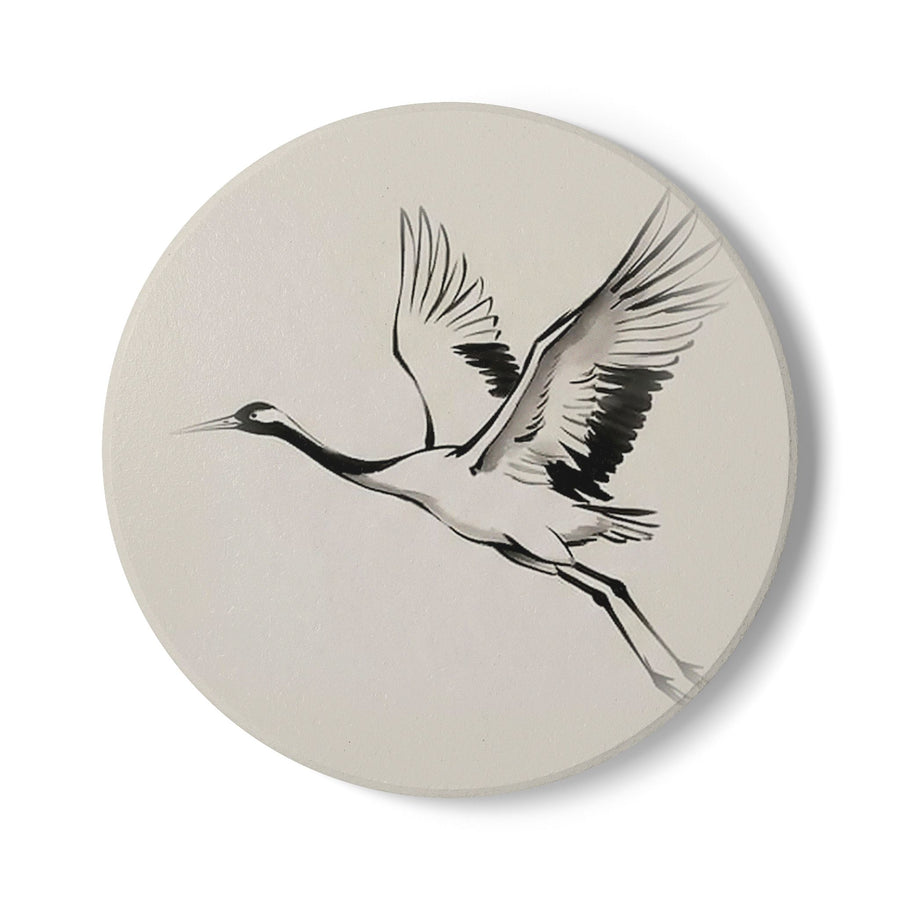
On a sumi-e painting, the seal is often the only colour on the page. That single note of red against black ink and soft paper is one reason ink art feels so alive while staying so quiet. If you want to understand the painting that surrounds the seal, our guide what is sumi-e explains the brush, the ink and the one-stroke discipline.
In a Japandi room, this works the same way. A wall of pale plaster, oak furniture and linen benefits from one small, warm accent, and a seal on a print can provide exactly that without adding anything else. It is a good example of the restraint described in our introduction to Japandi: one deliberate detail rather than many.
Why we seal our work
For us, a seal is a promise of authorship. Each design begins as brush and ink in our Copenhagen studio, and the seal marks the moment we consider the piece finished.
It also connects our work to a long and generous tradition. We are not a Japanese studio, and we do not pretend to be. The seal is our way of acknowledging what we have learned from ink painting: that the last mark on a page should be small, considered and placed with care.
Framing and hanging prints with a seal
Because the seal is part of the composition, it should never be hidden. A few practical points:
- Check the mount opening. Seals often sit near the edge of the image. Make sure the mount does not cover them; a slightly wider opening is better than a cropped seal.
- Choose a soft-white mount. Bright white makes the red look harsh, while a warm off-white lets it glow. Our guide on how to frame art prints covers mount colour and width.
- Keep surrounding colour quiet. Let the seal be the only red on that wall. A red cushion directly beneath can feel like it is competing. For more on framing in this style, see how to frame art prints the Japandi way.
Give the piece room around it, too. Like the empty paper in the painting, the empty wall lets a small mark speak; our guide to the art of negative space explains why.
A small mark with a long history
The hanko seal is easy to overlook, but it carries a great deal: the artist's name, sometimes a favourite phrase, centuries of tradition, and the one point of colour that brings an ink painting to life. Learning to notice it changes how you look at Japanese and Chinese art.
When you choose ink art for your own walls, look for the seal and see where the artist placed it. It is often the quietest part of the picture, and frequently the most telling.
Frequently asked questions
What is the red stamp on Japanese paintings called?
It is a seal, impressed with red paste. In everyday Japanese a personal seal is called a hanko or inkan, and the combination of an artist's inscription and seal on a work of art is known as rakkan. It identifies the artist and forms part of the composition.
Can you have your own hanko made?
Yes. Seal carvers make personal seals in stone, wood and other materials, and many will render a non-Japanese name in katakana or in seal script. If you want one for official use in Japan, check the local registration requirements first.
Why is the seal on Asian art always red?
Seal paste was traditionally made with cinnabar, a red mineral that is stable and long-lasting. Red also stands out clearly against black ink and pale paper, which is why it became the convention. Other colours exist but are rarely used for an artist's signature seal.