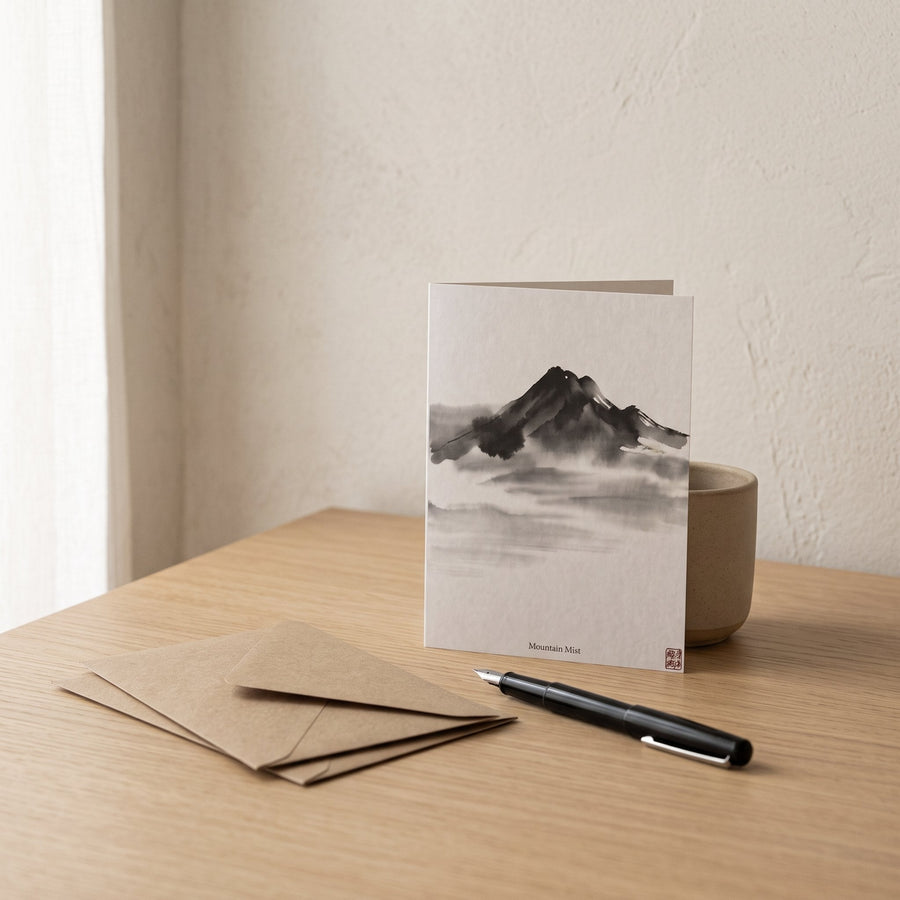
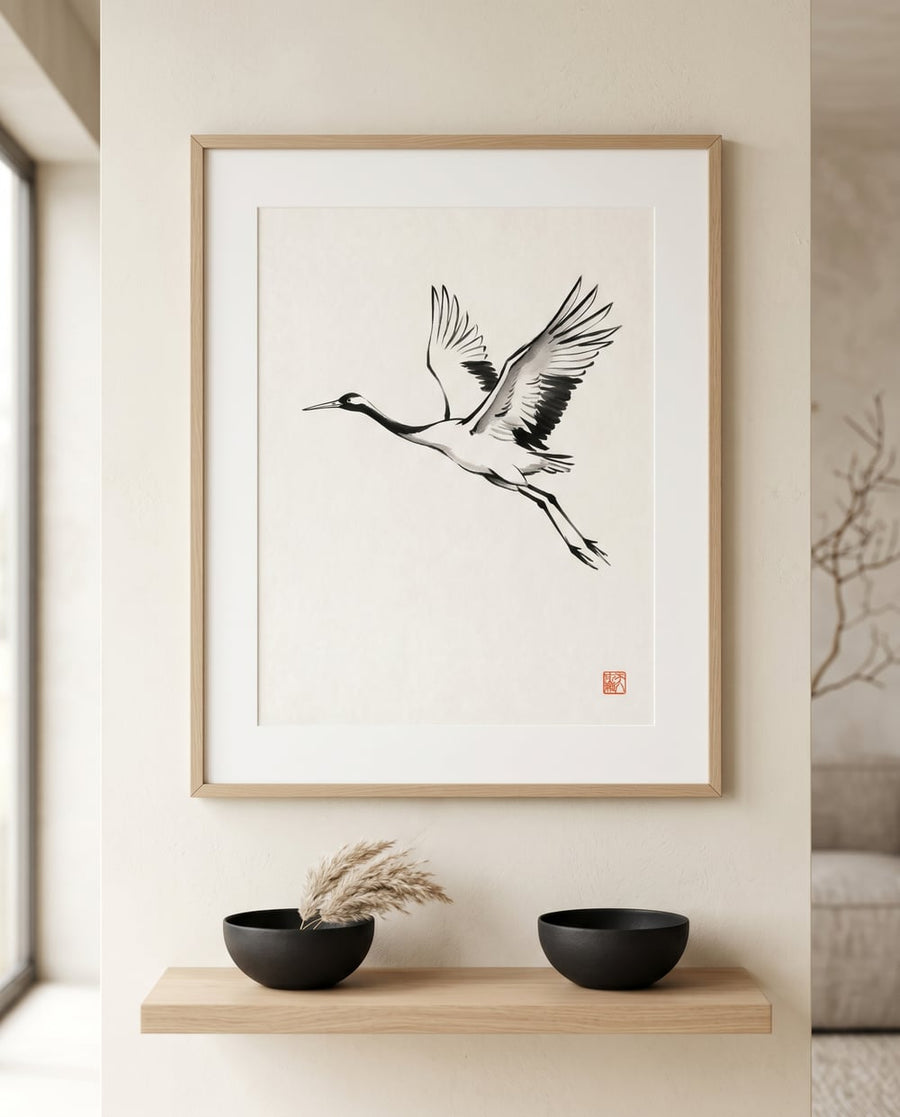
Sumi-e is Japanese ink painting: images made with a soft brush and black ink on absorbent paper, using as few strokes as possible. The name simply means "ink picture", from sumi (ink) and e (painting). What sets sumi-e apart is not the subject but the discipline: each stroke is laid down once, without correction, and the empty paper around it is treated as part of the picture.
That combination of economy, confidence and space is why sumi-e sits so naturally on Japandi walls. Below, we cover where the practice came from, the tools it relies on, how the one-stroke approach works, and how to choose and hang ink art at home.
A short history of sumi-e
Ink painting began in China, where monochrome landscape and bamboo painting developed over many centuries. It travelled to Japan largely through Zen Buddhist monks, who brought paintings, techniques and a way of seeing that valued directness over decoration.
By the Muromachi period (1336 to 1573), ink painting had become an art in its own right in Japan. The monk-painter Sesshū Tōyō, who studied in China, is often described as the greatest Japanese master of the form, and his landscapes show how much atmosphere a few washes of grey can hold. A little later, Hasegawa Tōhaku's folding screen of pine trees in mist pushed the idea further: most of the surface is left bare, and the trees seem to appear and dissolve in the fog.
Over time the Japanese tradition grew distinct from its Chinese roots. Compositions became sparer, subjects more personal, and the influence of Zen practice more visible in the speed and simplicity of the brushwork.
The four treasures: the tools of ink painting
Sumi-e uses four basic tools, traditionally called the Four Treasures of the Study. Each has a direct effect on how a painting looks.
- The brush. Made from animal hair set into bamboo, a good brush holds a reservoir of ink and comes to a fine point. Pressing down spreads the hairs into a broad stroke; lifting returns them to a line. One brush can paint a bamboo stalk and its finest leaf.
- The ink stick. Solid ink made from soot bound with glue, pressed into a bar. It is never poured from a bottle in the traditional practice.
- The inkstone. A smooth, slightly abrasive stone with a well. The painter grinds the ink stick against it with a little water. How long you grind controls how dense the black becomes.
- The paper. Thin, absorbent paper takes ink instantly and does not forgive hesitation. If the brush pauses, the ink spreads; if it moves quickly, the stroke dries with a broken, airy edge.
Grinding the ink is often described as part of the painting itself. The slow, repetitive movement settles the hand and the mind before the first stroke is made.
One stroke, no second chances
The heart of sumi-e is the single, committed stroke. Because the paper absorbs ink immediately, a line cannot be painted over or tidied up. Painters practise the same subject hundreds of times so that, when it matters, the hand moves without doubt.
The four gentlemen
Traditional training often starts with four plants known as the Four Gentlemen: bamboo, orchid, plum blossom and chrysanthemum. Each teaches a different stroke. Bamboo teaches the strong, jointed vertical; orchid the long, turning leaf; plum the knotted branch and small round blossom; chrysanthemum the layered petal.
Tone instead of colour
Sumi-e uses one colour, yet a good painting seems full of them. By changing how much water is in the brush, painters move from glossy black to the palest grey, and a traditional teaching speaks of the "colours" of ink to describe this range. Distant mountains are pale; near rocks are dark. Mist is simply the paper left alone.
Space as part of the picture
The empty paper is not background. It is sky, water, fog or silence, and the painter composes it as carefully as the ink. This idea, closely related to the Japanese concept of ma, is the subject of our guide to the art of negative space.
Why sumi-e suits a Japandi wall
Japandi rooms are built from natural materials, a narrow palette and a willingness to leave things out. Sumi-e shares every one of those instincts, which is why ink art rarely looks out of place in a Japandi room, as our introduction to Japandi basics explains.
- Black, white and grey work with any wood. Ink sits as comfortably beside pale ash as beside dark walnut, and it never clashes with a sage or clay accent.
- It holds the eye without filling the room. A single branch or mountain gives a wall a focal point but leaves the room quiet.
- It rewards a second look. The variation in a brushstroke, the dry edge where the ink ran out, the soft bloom where it pooled: these details appear slowly, which suits a room you live in every day.
Choosing and hanging sumi-e at home
Ink art looks its best with plenty of room around it. A few practical choices make the difference.
Pick one subject per wall
A single mountain, a lone branch or one ensō circle is stronger than a crowded gallery. If you want more than one piece, keep them the same size and subject family, and space them generously. The circle in particular carries a lot of meaning, which we unpack in the ensō and how to hang it.
Frame simply
Thin oak or black frames with a wide, soft-white mount give ink the breathing room it was painted with. Avoid heavy, ornate frames and bright white mounts that compete with the paper tone. Our guide on how to frame art prints covers mount widths and glass.
Look for the seal
Many ink paintings carry a small red seal near the edge. It is the artist's mark, and its placement is part of the composition; we explain its history in the red seal on Japanese art.
Mind the light
Ink and paper look best in soft, indirect daylight. Hang away from direct sun, which flattens the greys, and use a warm lamp in the evening so the paper keeps its gentle tone.
The quiet power of ink
Sumi-e asks very little of a room and gives a great deal back. A few confident strokes, a wide field of paper and a single red seal can anchor a wall more effectively than a large, colourful canvas.
If you are drawn to Japandi, sumi-e is one of the most natural ways to bring art into the home. Start with one piece you keep returning to, give it space, and let the ink do the rest.
Frequently asked questions
What is the difference between sumi-e and Chinese ink painting?
Sumi-e grew out of Chinese ink painting and uses the same tools and many of the same subjects. Over centuries the Japanese approach became sparer and more closely tied to Zen practice, with more empty space and fewer strokes. The two traditions remain closely related.
What is sumi ink made from?
Traditional sumi ink is made from fine soot mixed with animal glue and pressed into solid sticks. The painter grinds the stick against an inkstone with water to make liquid ink. Bottled ink exists, but many painters still prefer to grind their own.
Is sumi-e art good for a bedroom?
Yes. Its muted tones and open compositions suit rooms meant for rest. Choose a calm subject such as mist, water or a single branch, and hang it above the bed or opposite it where you see it last thing at night.