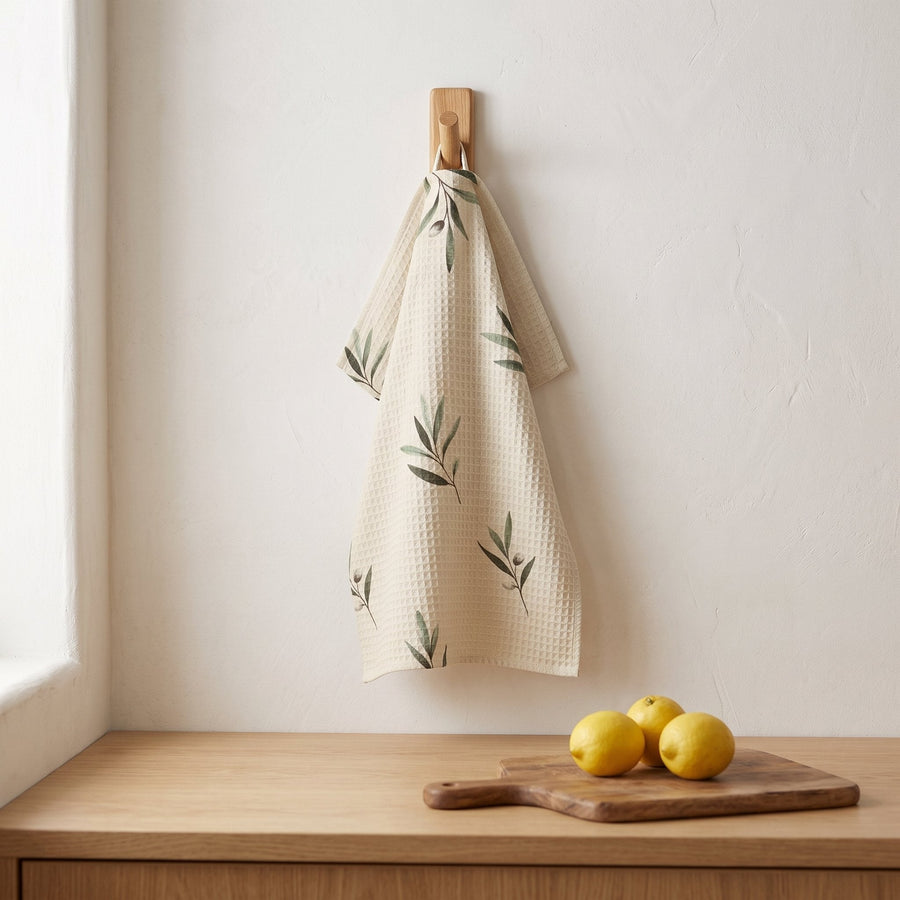
Japandi tea towels are the simplest piece of art in the kitchen: one well-made cloth with a quiet print, hung where you can see it, used every day and washed often. The Japandi approach treats a tea towel as both tool and decoration, so you choose fewer, better ones, display one at a time and rotate them with the seasons. This guide covers how to choose them, where to hang them so they read as art, and how to keep them looking good.
Why a tea towel counts as kitchen art
Most kitchens have very little wall space. Cabinets, tiles and appliances take most of it, and a framed print near the hob is rarely practical. A tea towel fills that gap. It is the one piece of printed design in the kitchen that sits at eye level, moves with you through the day and costs little to change.
Japandi rooms rely on a few objects doing a lot of work. In the kitchen, a single linen-coloured towel with a botanical or ink motif can carry the whole mood, in the same way a single stem carries a dining table. Our studio guide to the single stem rule describes the same idea with flowers.
Choosing Japandi tea towels
A good Japandi tea towel is defined by three things: the fabric, the colour and the print.
Fabric
- Waffle weave cotton has a honeycomb texture that traps water, dries quickly and looks tactile even when folded. It is the most practical choice for drying dishes and hands.
- Flat-woven cotton or linen is smoother and better for polishing glasses, and it takes a sharp, detailed print. Linen is especially lint-free but creases more.
- Avoid thick terry in a Japandi kitchen. It is absorbent but reads as bathroom rather than kitchen, and it holds odours if it does not dry fast.
Colour
Keep the ground colour close to your walls or worktop: oat, stone, warm white or a soft grey. Then let the print carry one accent colour that already appears somewhere else in the kitchen, such as the green of a plant, the blue of a ceramic bowl or the rust of a terracotta pot. Our sibling guide to Japandi kitchen colours helps you find that accent.
Choose motifs drawn by hand rather than slogans or busy repeats. Olive branches, ginkgo leaves, single blossoms and loose ink washes all suit the style. A print with plenty of empty ground looks calmer when hung, because the fabric itself becomes part of the design.
How to hang a tea towel as art
Where and how you hang the towel decides whether it reads as clutter or as a deliberate object.
- On the oven rail, folded once. The classic place. Fold lengthways so the motif faces outwards and the edges hang level. One towel only; two side by side starts to look busy.
- On a wooden peg rail. A short oak or ash rail with two or three pegs holds a towel, an apron and perhaps a small basket. Hang the towel by a loop or fold it over the peg so the print is centred.
- On a single brass or iron hook beside the sink. Choose a hook in a material that matches your tap or cabinet pulls, so it looks part of the kitchen rather than an afterthought.
- Clipped to a wooden hanger on the wall. For a towel you love but rarely use, a simple trouser hanger or a pair of timber battens turns it into a small textile hanging. This works well in a dining nook or on open shelving.
Leave space around the towel. A clear area of wall or cabinet door either side is what lets the eye rest on it, which is the whole point.
Rotating tea towels with the seasons
One of the pleasures of Japandi tea towels is how easily they change the feel of a kitchen. Instead of buying a drawer full of mismatched cloths, keep a small set of three or four and rotate them.
- Spring: blossom and soft pink, or a fresh green botanical, to match the first flowers on the table.
- Summer: olive and sage, wild meadow flowers, or pale indigo, which look cool against warm light.
- Autumn: persimmon, ginkgo gold or warm ochre, echoing fruit in a bowl and the turn of the leaves outside. Our guide to Japandi autumn decor builds on this palette.
- Winter: ink black on cream, or a deep blue, with the kitchen candlelit in the late afternoon.
Store the resting towels folded in a drawer or a lidded basket. Rotation also spreads the wear, so each towel lasts longer.
Caring for your tea towels
Tea towels work hard, and good care keeps both the print and the absorbency.
- Wash warm, not hot. A warm cycle removes kitchen grease without stressing printed colour. Wash with similar colours.
- Skip fabric softener. Softener coats the fibres and makes towels less absorbent. A splash of white vinegar in the rinse keeps them soft and fresh instead.
- Tumble low or line dry. High heat shrinks cotton and fades prints faster. Shake out the towel and smooth it before drying to reduce creasing.
- Iron while slightly damp if you want a crisp fold for display. Turn it over and iron the back of the print.
- Keep a working towel and a display towel. Use a plain cloth for oily pans and spills, and save the printed one for hands and clean dishes.
The same principles apply to linen napkins and aprons; our linen care guide covers natural fibres in more depth.
A kitchen that feels finished
Japandi tea towels are a small decision with a large effect. Choose absorbent cotton in a quiet ground colour, pick prints drawn by hand, hang one at a time with space around it, and rotate a small set through the year. The kitchen will feel more cared for, and you will reach for something you like every time you dry your hands.
If you are rethinking the whole room, start with our guide to the Japandi kitchen, then read the Sunday morning kitchen for the small rituals that make it feel lived in.
Worth considering
A few well-made pieces we would happily put next to our own. These are Amazon links; as an Amazon Associate we earn from qualifying purchases, at no cost to you.
- Wooden wall hooks, set of three — A short row of wooden pegs for the towel on display, with room for an apron beside it.
- Lidded seagrass storage boxes, set of two — A lidded basket for the resting towels while one is out, ready for the next seasonal swap.
- Stoneware utensil crock with beech utensils — Plain stoneware and pale wood beside the hob, a quiet companion to a printed towel on the rail.
Frequently asked questions
What size is a standard tea towel?
Most tea towels measure roughly 40 × 65 cm, though sizes vary between makers. That size folds neatly over an oven rail and is large enough to dry a stack of plates. Larger towels are useful for proving dough or covering bowls.
Are waffle towels good for drying dishes?
Yes. The raised waffle texture holds water well and dries quickly between uses, which keeps the towel fresh. Flat-woven linen is slightly better for polishing glasses to a streak-free finish.
How often should you wash kitchen tea towels?
Every two to three days for a towel in daily use, and straight away after it touches raw meat or spills. Rotating between two or three towels makes this easy and keeps one always clean and on display.