Japandi kitchen colours come down to three things: oak or a similar pale wood, an off-white with warmth in it, and one earth tone that appears mostly in textiles, ceramics and the odd painted surface. Cabinets and walls take the first two; aprons, tea towels, mugs and boards carry the third. Below is how to choose each, what to paint and what to leave to fabric, and the handful of colours that make a kitchen look cold.
The kitchen is the most hard-surfaced room in the home, which is why colour behaves differently here. There is no sofa to soften a wall and no rug to warm a floor. That makes the small soft things matter more than anywhere else, an idea we come back to in our Sunday morning kitchen piece.
The three-part Japandi kitchen palette
Most kitchens that feel Japandi rather than simply Scandinavian share the same three tones in roughly the same proportions.
- Oak, or one pale wood, around a third. Cabinet fronts, open shelves, a worktop or a table. One species, repeated, so that the grain reads as a single material rather than a collection.
- Warm off-white, around half. Walls, ceiling, tiles and any painted cabinetry. A white with a drop of ochre or a hint of pink, never a brilliant white with optical brighteners.
- One earth tone, the rest. Olive, clay, ochre, sage or a soft persimmon. This is the colour that makes the kitchen yours, and most of it should be in things you can wash and swap.
Black and stone are allowed on top of the three, as hardware, a tap, a worktop or a splashback, but they behave as materials rather than colours and should not compete with the earth tone.
Cabinets: wood, off-white or one of each
An all-oak kitchen is warm and forgiving of fingerprints, but in a small room it can feel heavy. An all-off-white kitchen is light and easy to live with but can look like a showroom without wood to ground it. The Japandi answer is usually both: wood on the base units, off-white on the walls units, or wood on an island and off-white everywhere else.
If you paint cabinets, choose a flat or very low-sheen finish and take the colour a tone warmer than you would for a wall, because cabinet doors sit in shadow beneath worktops and overhangs. Mushroom, putty and pale sage all work as painted cabinet colours; they read as neutrals and let the oak stay the star.
The one cabinet colour to approach with care is dark green or navy. It is everywhere, and it is not wrong, but it tips a kitchen out of Japandi and into something heavier. If you want depth, a warm charcoal on base units only, with oak above, keeps the calm.
Walls, tiles and worktops
Paint the walls and ceiling the same warm off-white so the room reads as one volume. Kitchens are full of horizontal lines already, from worktops, shelves and the tops of tiles, and a change of colour at the ceiling adds one more.
Tiles should be matt or softly glazed and close in tone to the wall. A handmade-looking white or bone tile with slight variation is the most Japandi option; a glossy pure white tile is the least. If you want colour in the tiles, use the earth tone in a single row or on the splashback behind the hob only, and skip it in the textiles so the room has one accent rather than two.
Worktops in pale stone, oak or a warm composite all suit the palette. Cool grey composites are the common mistake, because they pull the whole room towards blue and make oak look orange.
Where the colour really lives: textiles and ceramics
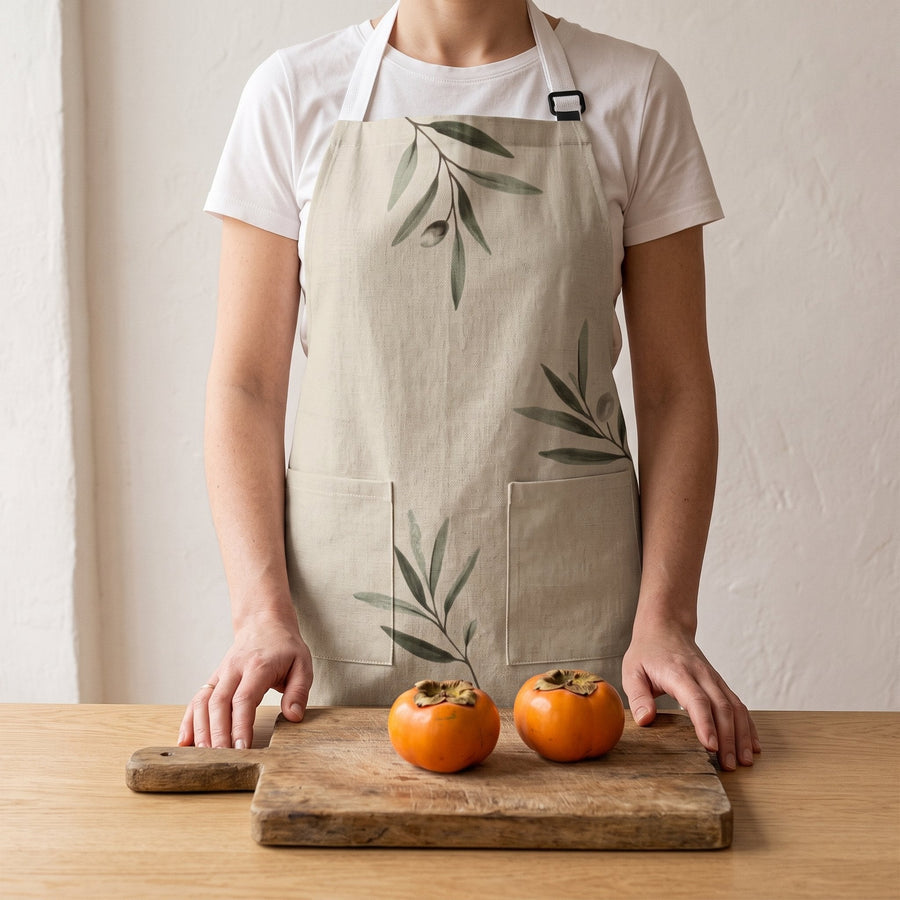
A kitchen's earth tone belongs mostly in things that are used with the hands. An apron on a hook, a folded tea towel, a linen runner on the table, the glaze of a mug, the engraving on a board. These are small, they are seen at close range, and they can be washed or changed when the season or your mood changes. Paint cannot.
The order of operations we suggest for adding colour to an existing off-white and oak kitchen:
- Choose the earth tone from what you already own. A favourite mug, a bowl, a jar of olives on the counter. The kitchen tells you its colour before you decide it.
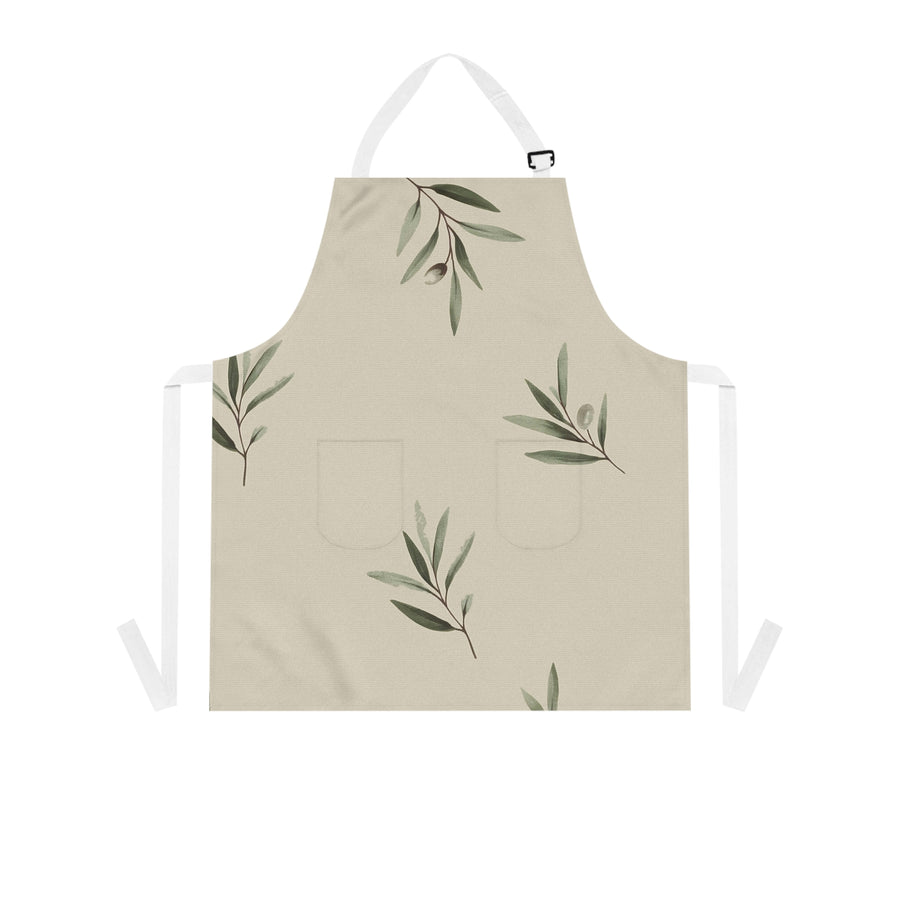
- Add it in linen. An apron or a pair of tea towels in that tone. Hang them where they are seen; they are the largest soft surfaces in the room.
- Repeat it in ceramic or wood. Two mugs, a set of coasters, one engraved board leaning against the splashback. Three appearances in three materials is enough.
Stop there. A kitchen with olive in the apron, the towels, the tiles, the stools and the pendant lamp is a themed kitchen, and the calm goes.
Matching the kitchen to the rooms around it
Open-plan kitchens share their colours with a dining or living area, and the palette has to survive the join. Keep the off-white identical across the whole space, let the oak carry through as the dining table or shelving, and use the same earth tone for the kitchen textiles and the dining textiles. A runner and napkins in the same olive as the apron make the two zones read as one; our Japandi dining room guide takes it from there.
In a closed kitchen you have more freedom, but continuity still pays. If the hallway outside is greige, take the kitchen's off-white a step towards greige rather than fighting it.
A tray on the worktop, holding the oil, the salt and a small plant, is the simplest way to gather the earth tone into one place and stop it spreading. We wrote about that in why your kitchen needs a tray.
Colours that make a Japandi kitchen feel cold
Brilliant white on walls and cabinets together, which turns the room blue under LED strip lighting. Cool grey worktops and grey-veined marble, which pull against oak. Stainless steel in large areas, which is fine on a tap but chilly on a whole splashback. And high-gloss anything, because Japandi surfaces absorb light rather than bounce it.
If you have inherited some of these, you do not need to rip them out. Warm the lighting to a low colour temperature, add oak in a board and a shelf, and put the earth tone in the textiles. The room will move most of the way on its own.
Warm, wooden and washable
A Japandi kitchen's colours should be so settled that you stop noticing them: oak, warm white and one earth tone, with the earth tone in the things you touch. The fixed surfaces stay quiet and the soft ones carry the character.
Build the room in that order, choose the accent from something you already love, and keep it to three appearances. For the wider room, including layout and storage, our Japandi kitchen guide continues where the colour leaves off.
Worth considering
A few well-made pieces we would happily put next to our own. These are Amazon links; as an Amazon Associate we earn from qualifying purchases, at no cost to you.
- AmorArc reactive-glaze stoneware dinnerware set, 18 pieces — Reactive-glaze stoneware is where the kitchen's third colour can live without painting anything.
- Stoneware utensil crock with beech utensils — Stoneware and pale beech by the hob, keeping the wood and earth tones together on the worktop.
- 17" acacia-wood tray with cut-out handles — Gathers oils and salt in one warm wooden plane, so the counter reads as wood rather than clutter.
- Stoneware salt cellar with wood lid — A small piece that repeats the stoneware and wood pairing at the scale of a single object.
Frequently asked questions
What colour cabinets suit a Japandi kitchen?
Pale oak or a similar light wood, warm off-white, or a combination of the two. Painted options that work are mushroom, putty and pale sage in a flat finish. Avoid glossy white and cool grey, and treat dark green or navy as a step away from the style.
Can a Japandi kitchen have colour?
Yes, one earth tone such as olive, clay, ochre or sage, used mainly in aprons, tea towels, mugs and boards rather than on fixed surfaces. Three appearances in three materials is enough; more starts to look themed.
What wall colour goes with oak kitchen cabinets?
A warm off-white with a hint of ochre or pink, on walls and ceiling alike. It keeps the oak looking natural rather than orange, which is what a cool white or grey does to it.