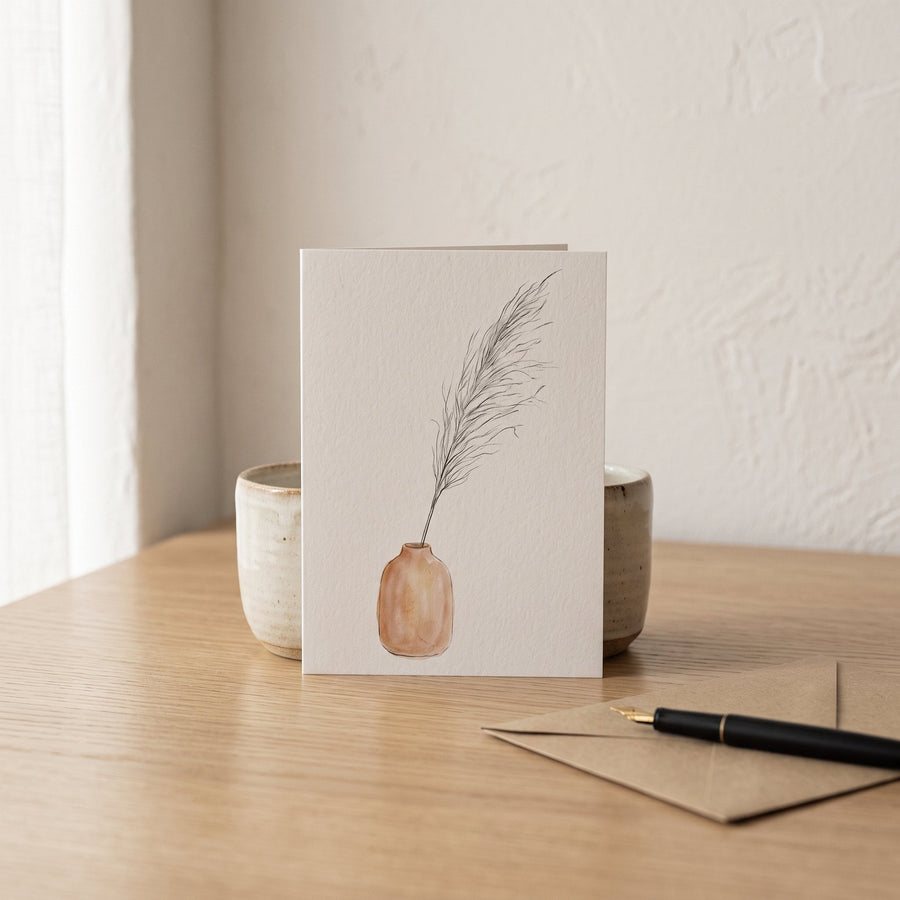
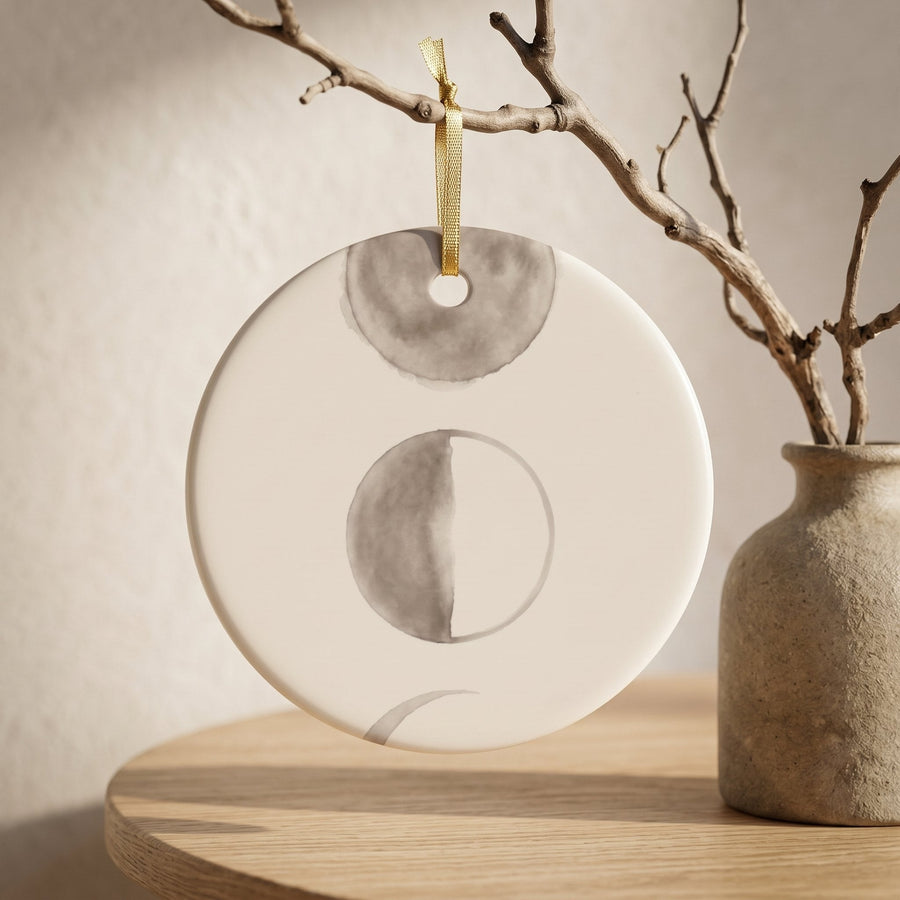
Japandi greeting cards are simple, well-made cards with a single piece of quiet art on the front and nothing printed inside, so the words are entirely yours. The style suits people who would rather write three honest lines than sign under a printed verse. Below, we look at why a card is worth treating as an object, how to choose one, and twelve short lines you can write when you are not sure what to say.
The card as an object
A handwritten card does something a message cannot: it stays. It sits on a mantelpiece for a week, gets tucked into a book, and turns up years later in a drawer. Because it lasts, the card itself matters as much as the words.
In a Japandi home, objects earn their place through material and restraint. A card printed on thick, uncoated stock feels like paper rather than plastic. A single ink drawing on the front, with space around it, looks like a small print rather than packaging. Many people end up framing a card they love, which is the best test of whether it was worth sending. Our guide to the art of negative space explains why so little on the page can feel so complete.
How to choose Japandi greeting cards
Paper
Look for heavy card with a matte, uncoated finish. It takes ink from a fountain pen or a pencil without smudging, and it has a soft, slightly warm feel in the hand. Glossy card resists ink, shows fingerprints and looks less natural. If you are curious about how paper finish changes art, our sibling guide comparing matte vs fine-art paper goes into detail.
Artwork
Choose one motif, drawn by hand, in a muted palette: a single stem, a branch of blossom, a still pond, a brush circle. Avoid glitter, foil and slogans, which date quickly and limit when the card can be used.
Blank inside
A blank card works for any occasion: birthday, thank you, sympathy, congratulations or simply thinking of you. Keep a small stack in a drawer and you will never need to rush out for the right card again.
What to write: twelve short lines
The hardest part of a blank card is the first line. These are short enough to fit with room to spare, and specific enough to sound like you. Adapt them freely.
For thanks
- "Thank you for the long lunch and the longer conversation." Naming the specific moment matters more than the size of the thanks.
- "Your help made a hard week feel lighter. I will not forget it." Good for colleagues, neighbours and friends who stepped in.
- "Every time I use the bowl, I think of you." A thank you for a gift that tells the giver it is part of daily life.
For birthdays
- "Here is to a slow, good year, with time for the things you love." Warm without being sentimental.
- "I hope this year is as kind to you as you are to everyone else." For a friend who gives a lot.
- "Another year of knowing you. Lucky me." Short, and it works for partners and old friends alike.
For a new home or a new beginning
- "May the light be good and the neighbours quiet." A housewarming line with a little humour. Our sibling guide to Japandi housewarming gifts has ideas for what to bring with it.
- "New rooms, same you. I cannot wait to visit." For a friend who has moved away.
- "Congratulations. You worked so hard for this, and it shows." For a new job, a degree or a finished project.
For difficult moments
- "I am thinking of you, and I am here whenever you need me." Simple, and it does not ask anything of the reader.
- "There are no right words. I am so sorry." Honest, and often more comforting than a longer message.
- "No need to reply. I just wanted you to know I care." Takes away the pressure to respond, which matters at hard times.
After the first line, add one memory or one plan: "I keep thinking about that walk by the harbour", or "Dinner at ours when you are ready." Then sign off. Three or four lines is plenty.
Writing it well
A few small habits make a handwritten note feel more considered.
- Use a pen you like. A fountain pen or a fine felt-tip in black or dark blue suits uncoated card. Avoid ballpoints that skip on thick stock.
- Write a draft first. Especially for sympathy cards. Two minutes on scrap paper saves crossings-out.
- Leave space. Start a third of the way down and keep the lines short. White space around the words looks calm and generous.
- Address the envelope by hand. It is the first thing the recipient sees, and it tells them this is not a bill.
Keeping a card drawer
The easiest way to send more cards is to have them ready. Keep a shallow box or drawer with a small mix of blank cards, envelopes, a good pen and a book of stamps. Choose three or four designs that suit most occasions, such as one botanical, one landscape and one abstract mark. Our journal piece on storage that does not look like storage has ideas for where to keep it.
A card drawer also makes gifting easier. A card and a small, useful object, such as a candle or an engraved mug, makes a complete present. Our Japandi gift guide lists pairings that work well.
A few words, kept for years
Japandi greeting cards are about care rather than decoration: good paper, one quiet image and a blank page that asks you to say something true. The words do not need to be clever. A short, specific line in your own handwriting will mean more than any printed verse.
Keep a few cards ready, choose designs you would be happy to see framed, and send them more often than you think you need to. The people who receive them will keep them.
Worth considering
A few well-made pieces we would happily put next to our own. These are Amazon links; as an Amazon Associate we earn from qualifying purchases, at no cost to you.
- Lidded seagrass storage boxes, set of two — A shallow lidded box for blank cards, envelopes, a good pen and stamps, so a card is always ready.
- Bamboo expandable drawer dividers, set of four — If the card drawer is a real drawer, these keep cards, envelopes and pens in their own lanes.
Frequently asked questions
What do you write in a blank greeting card?
Start with one specific line about the person or the occasion, add a memory or a plan, and sign off. Three or four short lines is enough. Specific details, such as a shared meal or a place, feel more personal than general wishes.
Are blank cards suitable for sympathy messages?
Yes, and often better than printed sympathy cards, because you can choose your own gentle words. A calm botanical or landscape image on the front suits the occasion. Keep the message short and honest.
What pen is best for matte card stock?
A fountain pen, fine felt-tip or gel pen in black or dark blue works well on uncoated matte card. Let the ink dry for a minute before closing the card to avoid transfer onto the facing page.