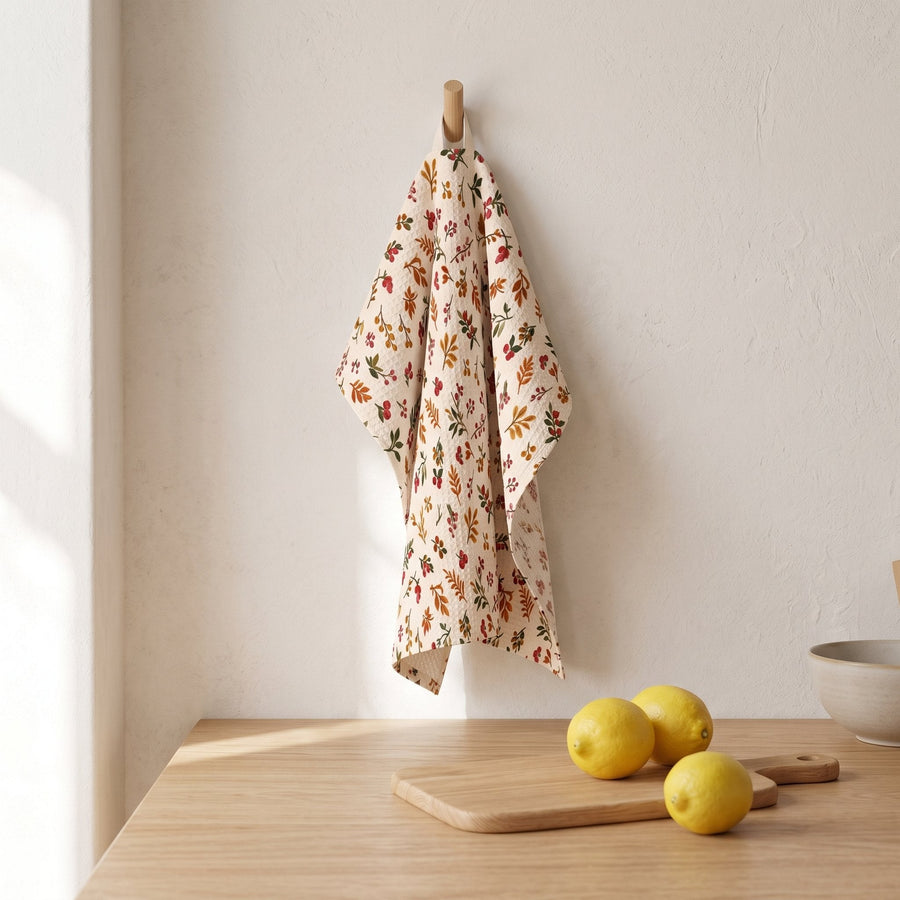
How to style a throw comes down to three folds and one rule about where it sits. Fold it in thirds lengthways and lay it over one arm of the sofa, fold it in half twice and drape it across the foot of the bed, or fold it loosely and hang it over the back of a chair. Whichever you choose, the throw should look like it was just used, not just arranged.
That is most of it. The rest is about weight, colour and knowing when to leave the throw alone, and it is worth going through because a throw is the textile that most often tips a calm room into a cluttered one.
The three folds worth knowing
There are dozens of ways to fold a throw and three that work in a Japandi room. Each suits a different piece of furniture, and once you know them you will not need the others.
The long fold, for a sofa arm
Lay the throw flat, fold it into thirds along its length so you have a long, narrow strip, then fold that strip in half. Drape it over one arm of the sofa so the folded edge hangs on the outside and the loose ends fall towards the seat. Let it fall naturally; do not square it up. This is the fold that reads as "someone was reading here" rather than "someone was styling here".
The foot-of-bed fold
Fold the throw in half lengthways, then in half again, so it becomes a wide band roughly a third of the bed's width in depth. Lay it across the foot of the bed with the folded edge towards the pillows and the open edge hanging slightly over the end. Pull one corner down a few centimetres so the band is not perfectly level. On a bed the throw is doing a practical job as well as a visual one, and it should look ready to be pulled up.
The chair drape
Fold the throw in half, then gather it loosely by one edge and hang it over the back or one arm of a chair so most of the fabric falls on one side. This is the most casual of the three and it only works with a throw that has real weight; a thin one just looks like laundry.
Where a throw should sit, and where it should not
A throw belongs where a person would put it down. On a sofa, that is one arm, usually the one furthest from the door, or the corner where the arm meets the back. On a bed, it is the foot. On a chair, the back. It does not belong in the exact centre of anything.
The rule we use in the studio is one throw per piece of furniture and never more than two throws in a room. A sofa with a throw and an armchair with a throw is a room with a habit; three throws and a basket of spares is a shop.
Throws also need space around them. If the sofa is already carrying five cushions, a throw over the arm turns into a pile. Take a cushion away first. Our guide to how many cushions belong on a sofa covers the arithmetic, and layering textiles explains how the throw, cushions and rug divide the work between them.
How to style a throw by colour
A throw is a large block of colour, so it needs to belong to the room's palette rather than add to it. There are three safe positions for it.
- Tone on tone. A throw one or two shades away from the sofa fabric. Oatmeal on a stone sofa, warm grey on charcoal. This reads as texture rather than colour and is the quietest option.
- The room's accent. The throw picks up the one accent colour that already appears in the rug, a print or a cushion. A muted persimmon throw on a neutral sofa in a room with a persimmon rug ties the two together without introducing anything new.
- Natural undyed. Cream, ecru or the pale honey of undyed wool. This works in every Japandi room and is the answer when you are unsure.
What does not work is a throw in a colour that appears nowhere else. It will look like it belongs to a different room, because it does. If you want the wider logic of which tones sit together, the Japandi colour palette guide is the place to start.
Texture over pattern
On a sofa that already has a printed cushion, choose a plain throw with a strong texture: a waffle weave, a chunky knit, a herringbone. Save patterned throws for beds and plain chairs, where they are the only textile talking. A woven pattern ages better than a printed one; we compared the two in woven vs printed throws.
Weight and size matter more than fold
A throw that is too small or too light will not hold any fold. For a sofa, look for something around 130 by 170 cm and heavy enough that the long fold hangs straight rather than fluttering. For a double or king bed, 150 by 200 cm or larger, so the foot-of-bed band reaches at least two thirds of the way across.
Wool, cotton and heavier blends hold shape. Thin acrylic fleece does not, and no amount of folding will make it look considered. If a throw feels light in the hand, it will look light on the sofa.
Two throws can be layered on a bed in winter, one folded at the foot and a lighter one turned down over the duvet edge, but keep them in the same colour family. Our Japandi bedroom guide shows how this sits within the whole bed.
Leaving it alone
The most useful thing to know about styling a throw is when to stop. A throw that has been used, pushed aside and half folded back is doing its job. Restyling it every evening to a photograph is not the point of the room.
Fold it well once, put it where a person would leave it, and let it live. A throw that is the right weight and the right colour will look right almost however it lands, which is why those two decisions matter more than any fold. For the room around it, our Japandi living room guide covers the larger pieces the throw has to sit with.
Frequently asked questions
How do you drape a throw blanket over a sofa?
Fold it in thirds lengthways, then in half, and lay it over one arm with the folded edge on the outside and the loose ends falling towards the seat. Let it drop naturally rather than squaring it up, and keep it to one arm rather than the middle of the sofa.
Where do you put a throw on a bed?
Across the foot of the bed, folded into a wide band about a third of the bed's width in depth, with the folded edge towards the pillows. Pull one corner slightly out of line so it looks used rather than staged.
What colour throw goes with a grey sofa?
A warmer grey or oatmeal for a tone-on-tone look, or the room's existing accent colour, such as a muted rust or soft indigo picked from the rug or wall art. An undyed cream or ecru throw works if you are unsure.