The ginkgo leaf stands for endurance, long life and hope after hardship, and it earns those meanings honestly: the ginkgo is one of the oldest tree species alive, it is the official tree of Tokyo, and several ginkgo trees survived the bombing of Hiroshima and are still growing. Ginkgo symbolism is the reason the small fan-shaped leaf appears on so many prints, coasters and textiles in Japandi homes, but the shape does its own share of the work.
This guide covers where the meaning comes from, why the fan shape suits a quiet interior so well, and how to use the ginkgo motif in a room without it becoming a theme.
Ginkgo symbolism: endurance first
The ginkgo, Ginkgo biloba, is often called a living fossil. Its relatives appear in the fossil record from long before flowering plants existed, and the tree we plant today is the last surviving member of its whole division. That alone would make it a symbol of persistence, but the ginkgo has also proved remarkably tolerant of city life, poor soil, pollution and pests, which is why it lines so many streets in Tokyo, Seoul, New York and Paris.
In Japan the tree carries a second, more personal layer of meaning. A number of ginkgo trees within a couple of kilometres of the centre of the Hiroshima blast survived and put out new leaves the following spring. They are still alive, and they are visited as symbols of recovery and peace. When a ginkgo leaf is given as a card or hung on a wall, that story sits quietly behind it: things that look finished can come back.
Longevity and the temple ginkgo
Ginkgo trees can live for over a thousand years, and some of the most famous specimens in Japan and China grow in temple grounds, where they were planted deliberately for their long lives and their resistance to fire. That association with temples gives the leaf a certain calm; it is the tree that has seen everything and is still standing in the courtyard.
Tokyo's tree
The ginkgo leaf was adopted as the symbol of Tokyo in 1989, and a stylised version appears on the metropolitan crest, on manhole covers and on the trees that turn the avenues gold each November. Ginkgo autumn, when the leaves fall almost all at once and cover the pavements in yellow, is a small annual event in the city. For anyone who has walked through it, the leaf is a memory as much as a symbol.
Why the fan shape works so well in Japandi design
Meaning explains why the ginkgo is chosen; the shape explains why it keeps being chosen. The leaf is a shallow fan, usually with a single notch splitting it into two lobes, held on a slim stalk. It has no serrated edge, no complicated venation to draw, and no obvious front or back. Drawn in ink it can be a single stroke; cut from wood or engraved into stoneware it stays legible at any size.
That simplicity is what Japandi design asks of a motif. The style relies on a limited palette, honest materials and a few well-chosen objects, and a decorative element has to hold its own against oak, linen and unglazed clay without shouting. A ginkgo leaf does this because it reads as both natural and geometric at once: it belongs to the same family of forms as a folded fan or a scallop, so it looks at home beside clean-lined furniture. Our overview of the principles of Japandi goes into why that balance between organic and ordered matters.
The fan also gives a designer a built-in sense of direction. A leaf pointing up feels like growth; a leaf tilted and falling feels like autumn; a scattering of leaves feels like wind. Those are three distinct moods from a single shape, which is why the same motif can suit a nursery card, a sympathy card and a hallway print.
Ginkgo colours: gold, green and ink
The ginkgo has two natural colours and one that belongs to art. In summer the leaves are a soft, bright green; in autumn they turn a pure, uniform yellow that is unusual among trees, with none of the reds and browns of a maple. In Japanese and Chinese painting the leaf is most often shown in black ink, and in modern design it appears in gold foil, brass or mustard as a nod to the autumn colour.
For a Japandi room, ink and gold are the useful pair. A black ink ginkgo on off-white paper sits comfortably in the palette of warm neutrals that the style is built on, and a single touch of mustard or brass in the same room picks up the leaf without repeating it. If you are working out which shade of ochre or yellow suits your walls, our guide to Japandi accent colours covers the warm side of the palette.
How to use the ginkgo motif without overdoing it
Because the leaf is so easy to like, it is easy to overuse. The rule we follow in the studio is one strong ginkgo and, at most, one quiet echo of it in the same room. Some combinations that stay on the right side of the line:
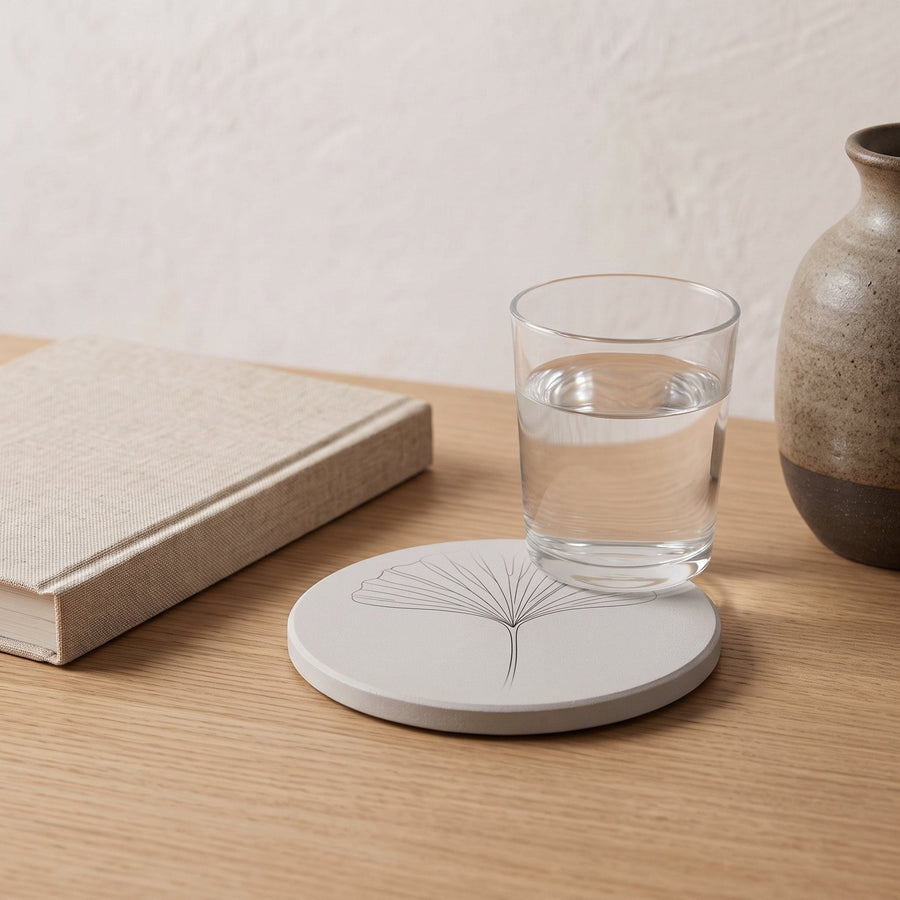
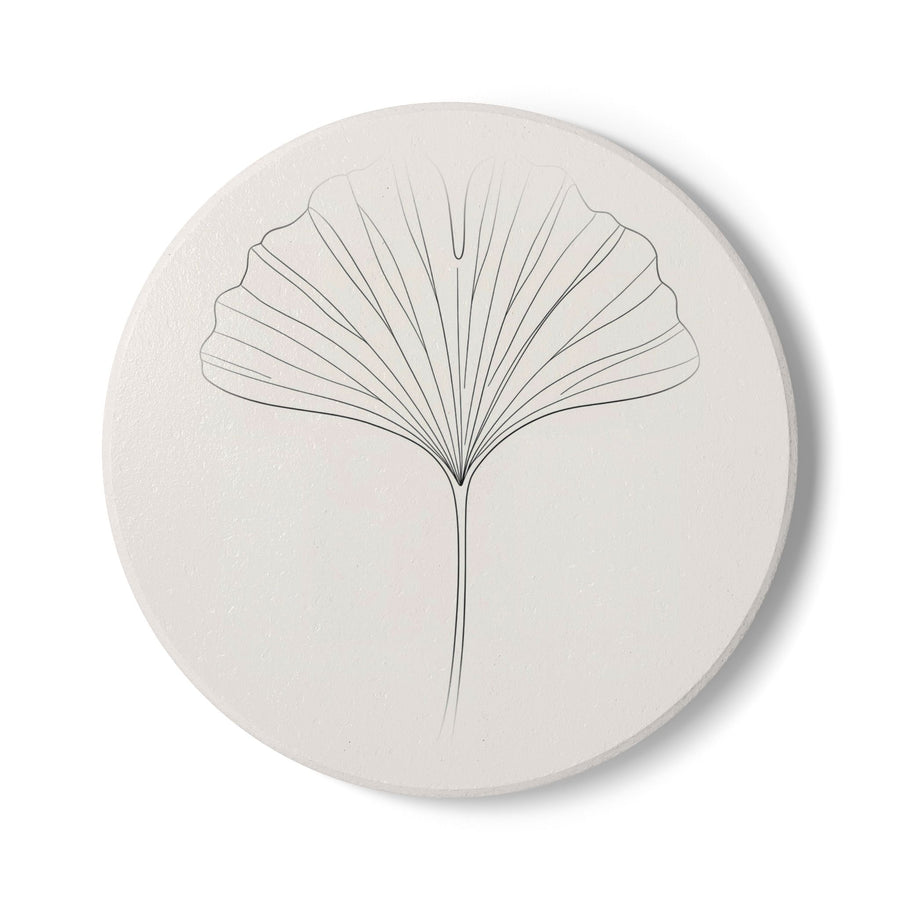
- Print above, coaster below. A single ginkgo print on the wall and an engraved ginkgo coaster on the side table underneath. The eye connects the two; a third instance would start to feel like a set.
- Card on a shelf, nothing else. A ginkgo greeting card propped on a picture ledge among plain ceramics is often enough for a whole room, and it can be swapped with the seasons.
- The entryway leaf. A small ginkgo print by the door works as a welcome and as a reminder of the tree's resilience on the way out in the morning. Our Japandi entryway guide has more on scaling art for a narrow hall.
- Ginkgo with a real stem. If you have access to a ginkgo tree, a single branch in a bud vase beside a printed leaf is a lovely pairing in autumn and honours the single-stem rule.
Avoid pairing a ginkgo print with other botanical motifs at the same scale on the same wall. A ginkgo and an olive branch, say, will compete. A ginkgo and an abstract ensō will not, because one is a plant and the other is a gesture.
Ginkgo as a gift
Few motifs cover as many occasions. Because ginkgo symbolism is about endurance and recovery, the leaf is right for someone who has been ill, for a retirement, for a long friendship or for a new home that took a long time to reach. Because it is also Tokyo's emblem and an autumn icon, it suits a traveller, a gardener or anyone who simply loves November.
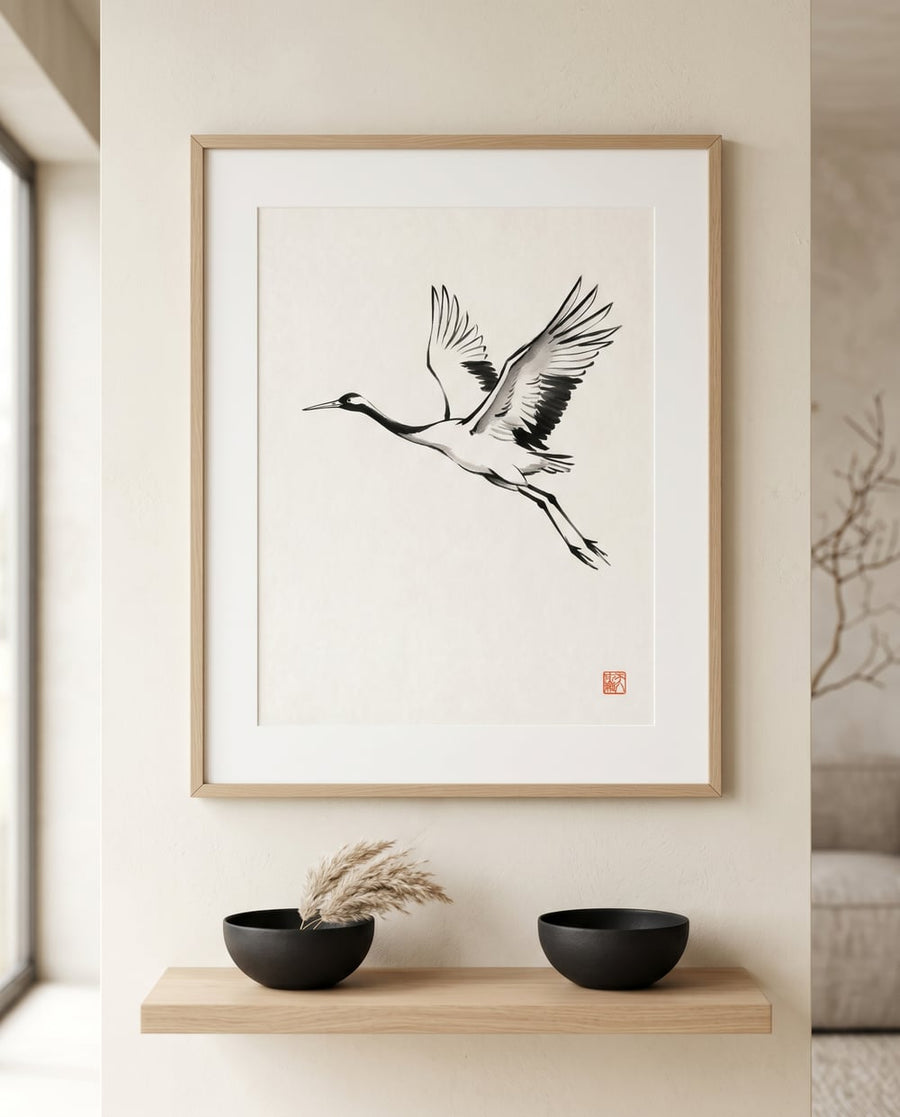
A card is the simplest form of the gift, and a card that is good enough to frame is better still. A coaster or a small print extends the same thought into something used every day. If you are choosing between motifs for a particular person, our guide to crane symbolism in Japanese art is a useful companion; the crane and the ginkgo are the two classic wishes for a long life, one animal and one tree.
A leaf that has earned its place
Ginkgo symbolism is not a decorator's invention. The tree has outlasted the dinosaurs, survived a city's destruction and been chosen by the largest metropolis on earth as its emblem, and the leaf carries all of that in a shape simple enough to engrave on a coaster. That is why it turns up so often in Japandi homes and why it rarely looks tired.
Use it once, in ink or gold, against a warm neutral wall, and let it mean what it means. Endurance does not need to be underlined.
Frequently asked questions
What does a ginkgo leaf symbolise in Japanese culture?
In Japan the ginkgo leaf stands for longevity, endurance and hope, drawing on the tree's great age, its resistance to fire and the ginkgo trees that survived the Hiroshima bombing. It is also the official symbol of Tokyo. The leaf is often used on gifts that carry a wish for a long life or a recovery.
Is a ginkgo leaf a good motif for a bedroom?
Yes. The ginkgo's meaning is calm and hopeful, and its fan shape is simple enough not to disturb a room meant for rest. A single ink ginkgo print above a low bed or a small card on the nightstand works well; avoid repeating the leaf on bedding and curtains at the same time.
Why is the ginkgo tree associated with Tokyo?
The ginkgo was chosen as Tokyo's official tree in 1966, and a stylised ginkgo leaf became the symbol of the Tokyo Metropolitan Government in 1989. The tree copes well with city conditions and lines many of the capital's avenues, which turn yellow each November when the leaves change colour and fall.