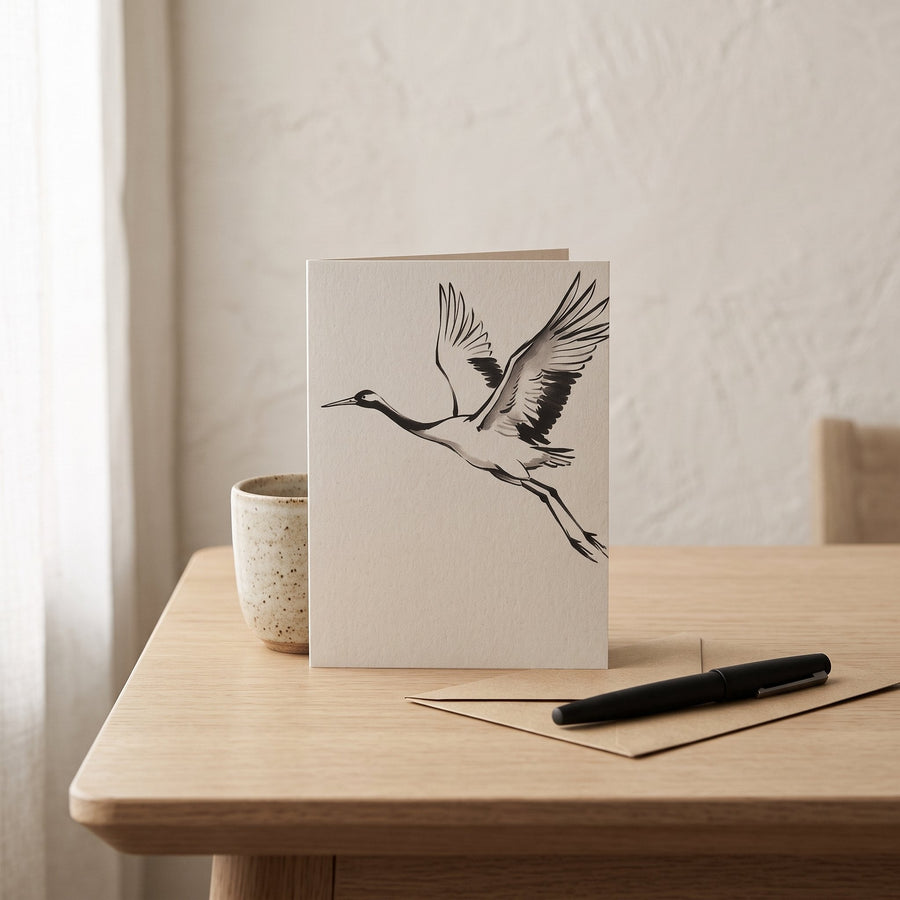
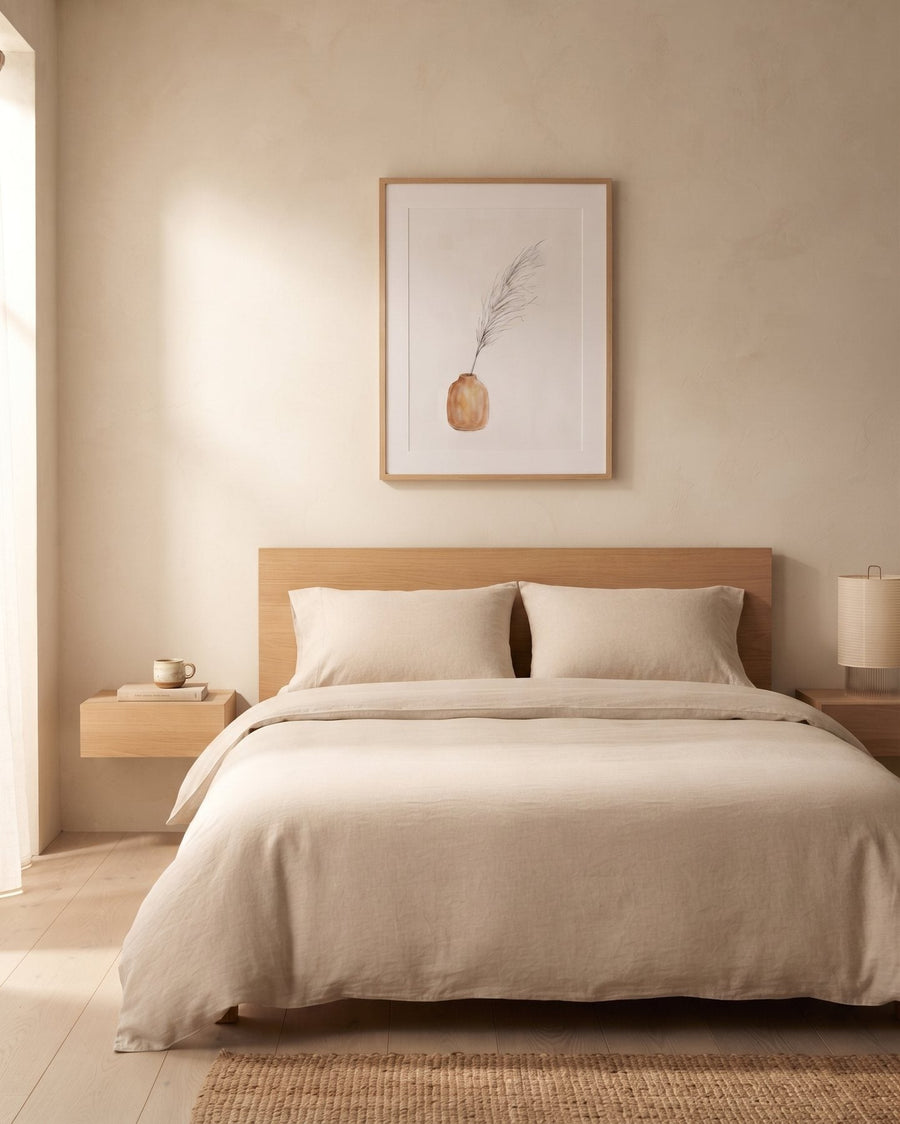
In Japanese art the crane stands for three things above all: a long life, a faithful partnership and the lift of good fortune. Crane symbolism in Japanese art grew out of an old saying that the crane lives a thousand years, and out of the plain observation that red-crowned cranes pair for life and return to the same wetlands each winter. Everything else, from wedding kimono to the folded paper crane, follows from those two ideas.
If you are choosing a crane print or card for a home, that meaning matters. It changes which room the piece belongs in, how it should be framed, and whether it is the right gift for the person you have in mind. This guide covers the meaning, the origami connection and the practical question of placement.
What the crane means in Japanese art
The Japanese word for crane is tsuru, and the bird most people picture is the red-crowned crane, or tanchō, with its white body, black wing tips and a patch of red on the crown. It is the crane of folding screens, lacquerware, textile patterns and the tails of aircraft, and it carries a small cluster of related meanings.
Longevity
A proverb pairs the crane and the tortoise: the crane for a thousand years, the tortoise for ten thousand. The two animals appear together on gifts for elders and on decorations for the New Year, where the wish is simply for more years, well lived. A crane on its own still carries that wish, which is why crane motifs turn up on cards for milestone birthdays and on the sleeves of celebratory clothing.
Loyalty
Red-crowned cranes form lasting pair bonds and perform a synchronised dance during courtship, bowing, leaping and calling in unison. That behaviour made the bird an emblem of a devoted marriage, and a pair of cranes is one of the most common motifs on the white wedding kimono, the shiromuku. A single crane reads as a wish for a long life; two cranes read as a wish for a long life together.
Lift
The third meaning is harder to name but easy to feel. Cranes were thought to carry souls upward and to move between the earthly and the heavenly, so a crane in flight became shorthand for aspiration, safe passage and a change for the better. In a room, this is the meaning you feel most directly: a crane with its wings open gives a wall a sense of rising air.
The crane in ink, on screens and in paper
Cranes appear in almost every Japanese medium, and the treatment tells you something about the period and the artist. On gilded folding screens they are painted in a rich, flat style, often in procession across gold leaf. In sumi-e, the ink-painting tradition, the same bird is reduced to a few strokes: a long line for the neck, a wash for the body, a dry flick of the brush for the black tail feathers. If you would like a grounding in that technique, our guide to what sumi-e is and how it works explains why so much is left out.
Then there is paper. The folded crane, orizuru, is the best-known origami model in the world, and it has its own layer of meaning. A string of a thousand folded cranes, called senbazuru, is made as a wish for recovery or long life and is often given to someone who is unwell or to mark a peace memorial. That association is one reason the crane is such a gentle gift motif: it says I hope you are well without spelling it out.
The origami crane also shapes how modern designers draw the bird. Many minimalist crane prints borrow the folded form's sharp angles and flat planes, so a crane can be recognisably itself even when it is little more than a triangle of neck and a fan of tail. In our own studio work we tend to sit between the two traditions: an ink-drawn body with the negative space of the origami model around it. The reasoning behind that restraint is set out in our piece on the art of negative space.
Reading a crane print: posture, pairing and direction
Once you know the meanings, a crane image starts to read like a short sentence. A few details carry most of the message.
- Standing or flying. A standing crane, often with one leg raised, is calm and watchful; it suits a bedroom, a study or an entryway. A flying crane is about lift and movement and works well above a sofa or in a stairwell where the eye is already travelling.
- Single or paired. One crane is a personal wish for longevity and belongs anywhere. A pair is a wedding, anniversary or new-home motif and makes a considered gift for a couple.
- Direction. Hang a flying crane so it heads into the room rather than out of a doorway. It is a small thing, but a bird flying towards the exit makes a space feel as if it is leaving.
- Companions. Cranes are often drawn with pine (endurance), plum blossom (early spring) or the rising sun (New Year). Each companion nudges the meaning. A crane among reeds, by contrast, is simply the bird at home in its marsh.
Where a crane belongs in a Japandi home
Japandi interiors work best with one or two motifs repeated with intent rather than a dozen competing images, and the crane rewards that discipline. Its long lines suit tall, narrow formats, and its palette of white, black and a single point of red sits happily against oak, linen and limewashed walls. If you are still deciding on the wider scheme, our Japandi colour palette guide shows how a single red accent can carry a whole room.
A few placements that tend to work:
- The bedroom. A single standing crane above a low bed reads as rest and long life, which is the right note for the room. Keep the frame slim and the mount generous.
- The entryway. A crane is a traditional welcome, so a small card or print by the door is appropriate as well as decorative. It also pairs well with a single stem in a bud vase, following the single-stem rule.
- The desk. Cranes are patient birds, which makes them a quiet companion for work. A postcard-sized crane propped against the wall behind a lamp is often enough.
- The gift table. A crane card for a wedding, an anniversary, a recovery or a significant birthday carries its meaning without a word of explanation, and many people frame them afterwards.
Framing is where most crane prints are let down. The image needs breathing room, so choose a mount at least as wide as the crane's neck is long and resist heavy black frames unless the rest of the room is dark. Our guide to how to frame art prints walks through mount widths, oak versus black and when to float a print instead.
Crane, koi and ensō: choosing between the classic motifs
People often arrive at the crane while weighing it against the other great Japanese motifs. The koi is about perseverance and ambition, the fish that swims upstream and becomes a dragon; it suits a hallway or an office where you want a sense of forward push. The ensō, the hand-drawn circle, is about the moment of making and the acceptance of imperfection, and it belongs in the calmest room in the house. The crane sits between them: aspiration without struggle, stillness with the possibility of flight.
If you want to compare the three properly, our guides to koi symbolism in art and the meaning of the ensō cover each motif in the same detail. A home rarely needs all three, but a crane in the bedroom and an ensō in the living room is a pairing we return to often.
A bird that carries a wish
Crane symbolism in Japanese art is generous rather than complicated: a long life, a faithful bond and a sense of lift. Because the meanings are warm and specific, a crane print or card rarely feels like decoration for its own sake. It is a wish made visible, and people tend to keep it.
Choose the posture that matches the room, give the bird white space, and let it be the only image on that wall. The crane has been doing its work quietly for a thousand years; it does not need help.
Frequently asked questions
What does a single crane symbolise in Japanese art?
A single crane represents longevity and good fortune, drawing on the proverb that the crane lives a thousand years. It is also associated with peace and with safe passage, which is why a folded paper crane is given to someone who is unwell. On its own it is an appropriate motif for almost any room and any recipient.
Is a crane print a good wedding or anniversary gift?
Yes, particularly a pair of cranes, which traditionally stands for a devoted, lifelong partnership and appears on Japanese wedding kimono. A single crane is a warmer, more general wish for a long life and suits a housewarming or a milestone birthday. Either works as a card that can later be framed.
Which way should a crane face when hung on the wall?
Hang a flying or walking crane so it faces into the room rather than towards a door or window. The bird then appears to arrive rather than leave, and the eye is drawn into the space. For a pair, have the two cranes face each other or move in the same direction, never away from one another.