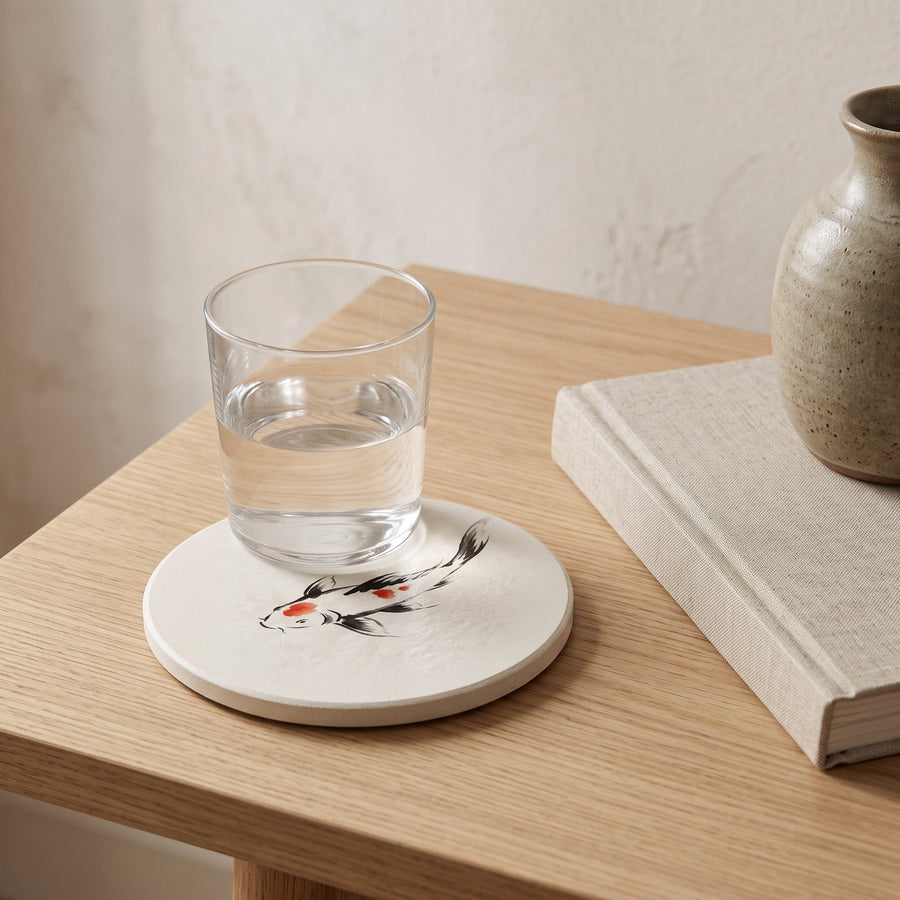
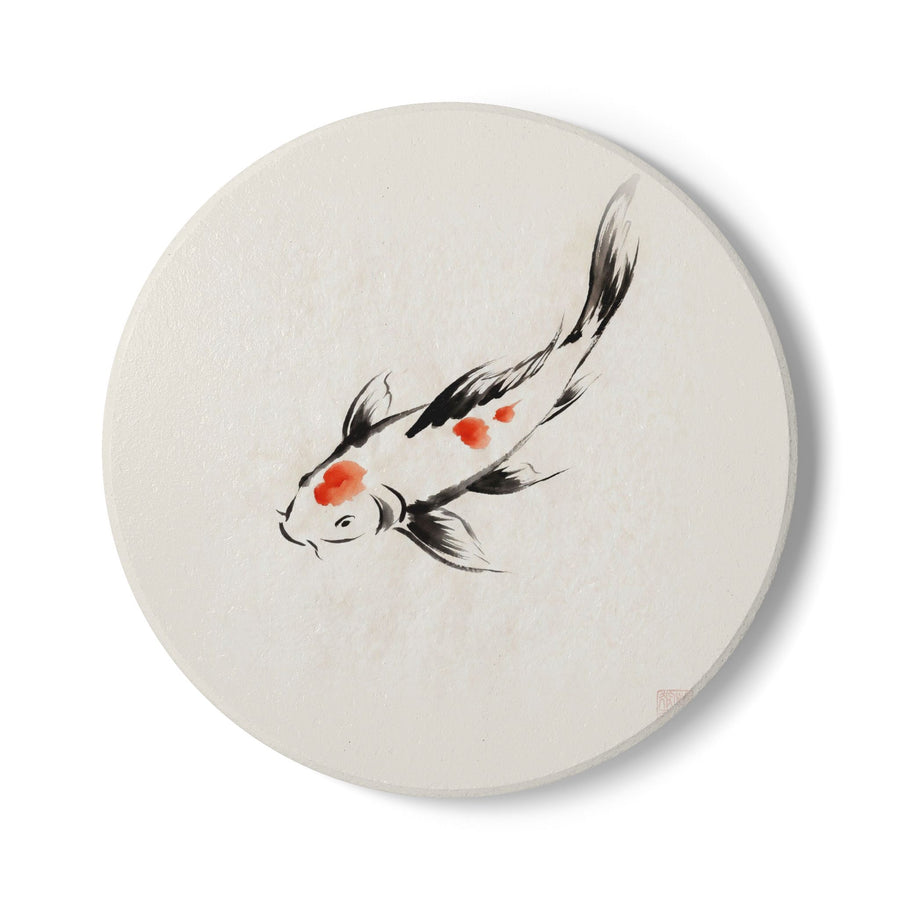
In Japanese art, koi symbolise perseverance, strength and the reward of effort, drawn from an old legend of a carp that swam upstream, leapt a great waterfall and became a dragon. A single koi usually speaks of determination; a pair often stands for love and partnership. Because the fish is almost always shown in moving water, koi art also carries a sense of flow, which makes it a lively but calm choice for a Japandi wall.
This guide covers where koi symbolism comes from, what the direction of swim and the number of fish are traditionally taken to mean, and which rooms suit koi art best.
Where koi symbolism comes from
The best-known story is Chinese. It tells of carp swimming against the current of the Yellow River towards a towering waterfall known as the Dragon Gate. Most give up; the few that persist and leap the falls are transformed into dragons. The tale became a metaphor for passing difficult examinations and, more broadly, for success won through persistence.
In Japan the story took on its own life. Every year around Children's Day on 5 May, families fly koinobori, carp-shaped streamers, from poles outside the home, wishing their children the strength to swim against the current of life.
The ornamental coloured koi most people picture today, with red, white, black and gold markings, were bred in Japan more recently, largely from the nineteenth century onwards. They have since become a symbol of Japanese gardens and a favourite subject for painters.
Koi symbolism in art: what the fish means
Koi symbolism is layered, and different traditions emphasise different meanings. These are the ones most consistently found in Japanese and Chinese art:
- Perseverance. The core meaning, from the Dragon Gate legend: the strength to keep going against resistance.
- Courage. Koi are said to remain calm even when caught, which led to their association with composure in the face of difficulty.
- Good fortune and abundance. In Chinese tradition especially, fish are linked with prosperity, and a pond of koi is a wish for plenty.
- Love. In Japanese, the word for carp, koi, sounds the same as a word for romantic love, though the two are written differently. That wordplay helps explain why pairs of koi are a popular image.
- Transformation. The leap from carp to dragon makes koi a symbol of growth and change, which is why they are often given at turning points in life.
Direction of swim, pairs and numbers
Much of what people read into koi art comes from the composition. These are popular interpretations rather than fixed rules, but they are worth knowing before you choose a piece.
Swimming upstream or downstream
A koi swimming upwards or against the flow is usually read as struggle and ambition still in progress. A koi swimming downwards or with the current is often taken to mean that the struggle is over and success has arrived. Neither is better; choose the one that suits the moment in your life, or the room's mood.
One koi
A single fish is the purest expression of perseverance and focus. It also suits a minimalist wall best, because one form against open paper or water gives the eye a clear point of rest.
A pair of koi
Two koi, often circling one another, suggest partnership, harmony and love. Pairs are a traditional gift for weddings and anniversaries. When the two fish are dark and light and curve around each other, the image also echoes the balance of opposites.
Several koi
Groups of koi in a pond suggest abundance and community. They can be beautiful, but in a Japandi room a busy pond scene tends to fill a wall quickly. Keep larger groups for a single, generous piece rather than a gallery arrangement.
Koi in ink painting
Koi have long appealed to ink painters because their bodies suit the brush: a long, curving stroke for the spine, quick marks for fins and tail, and soft washes for water. In black ink, without their famous colour, they become studies in movement, which is one reason ink koi suit a calm interior so well.
The crane is the other great animal of Japanese art and often appears alongside the koi in auspicious imagery. If you are deciding between the two, our guide to crane symbolism explains what it carries instead.
Where to hang koi art
Koi art is about water and movement, so it suits rooms where you want a sense of flow and energy without noise.
- The home office. Perseverance is a fitting idea above a desk. A single koi swimming upward keeps the meaning clear and the wall calm.
- The entryway. Koi are a traditional symbol of good fortune. A small piece opposite the front door greets people as they arrive; our guide to the Japandi entryway covers the rest of that space.
- The living room. A pair of koi above a sofa or sideboard brings warmth and a sense of togetherness. Keep the surrounding wall clear, as we explain in the art of negative space.
- The bathroom. The water theme makes koi a natural fit. Choose a framed print behind glass and hang it away from direct splashes; see our Japandi bathroom guide for the wider palette.
As for size, one larger koi piece usually works better than several small ones. Our guide to art print sizes explains how to match a print to the wall and furniture beneath it.
Choosing koi art you will keep
Koi symbolism is generous: perseverance, courage, love, good fortune and change, all held in one graceful form. The best piece for your home is the one whose meaning fits your life now, whether that is a single fish pushing upstream or a pair circling in calm water.
In a Japandi room, look for restraint. Ink rather than bright colour, one or two fish rather than a crowded pond, and plenty of open space around the image. Hung with care, a koi brings movement to a wall without disturbing the quiet of the room.
Frequently asked questions
What does a koi swimming upstream mean?
It is usually read as perseverance and ambition still in progress, recalling the legend of the carp swimming up the Yellow River to the Dragon Gate. Many people choose it as a reminder to keep going through a difficult stretch. A koi swimming downstream is often taken to mean a goal already achieved.
What do two koi fish symbolise?
A pair of koi traditionally symbolises love, partnership and harmony between two people. It is a popular wedding and anniversary image. When one fish is dark and the other light, the pair also suggests balance between opposites.
Is koi art good for a home office?
Yes. The koi's association with perseverance and steady effort suits a workspace well. Choose a single fish in a calm composition, such as an ink drawing, so the piece motivates without distracting.