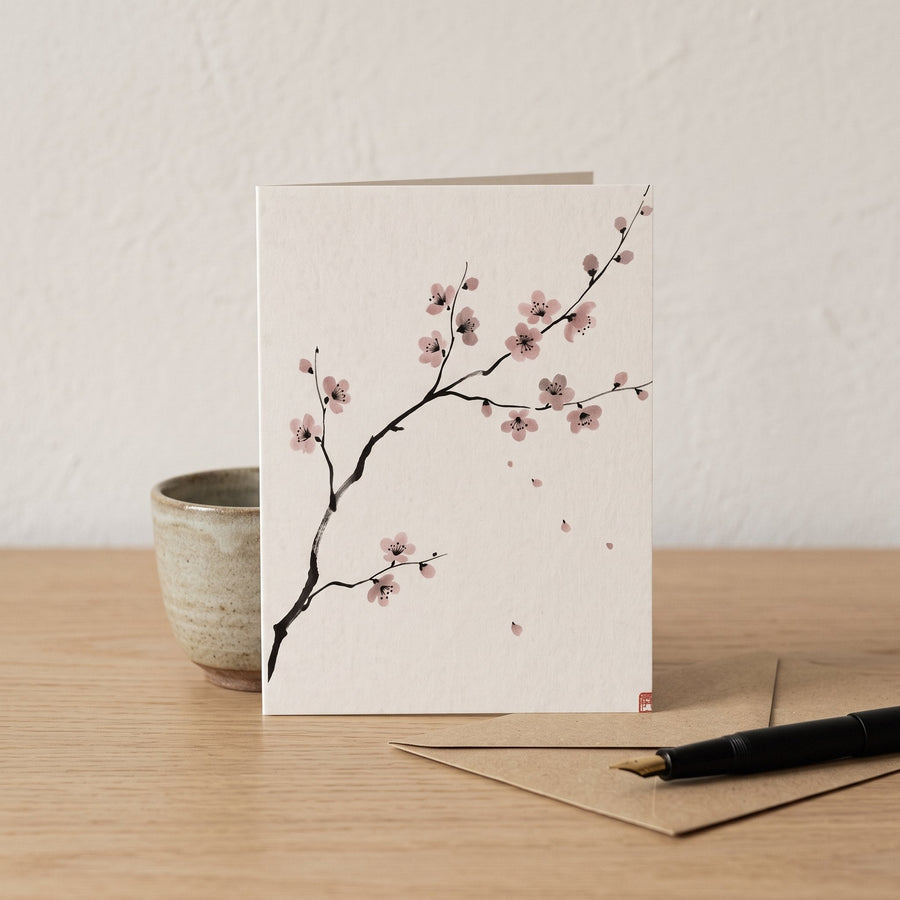
The quickest way to tell cherry blossom from plum blossom in a painting is the petal: cherry petals have a small notch cut into the tip, plum petals are smoothly rounded. Cherry flowers also hang in clusters on visible stalks, while plum flowers sit tight against the bare branch. Once you know those two tells, the cherry blossom vs plum blossom question answers itself in most prints, and it matters more than you might expect, because the two flowers mean different things.
This guide sets out the differences in shape, season and symbolism, and then the practical part: which blossom suits which room, and how to choose between them for a print or a card.
Cherry blossom vs plum blossom: the visual tells
Japanese and Chinese artists have been drawing both flowers for centuries, and they draw them differently on purpose. A few details do most of the work.
- The petal tip. Cherry (sakura) petals have a distinct notch or split at the end, giving each petal a slight heart shape. Plum (ume) petals are round and unbroken. Peach petals, for completeness, come to a soft point.
- The stalk. Cherry flowers grow on long stems in loose clusters, so they hang and sway. Plum flowers have almost no stem and appear to grow straight out of the wood, often singly or in pairs.
- The branch. Plum branches are drawn angular, knotted and dark, because the tree is old and bare when it flowers. Cherry branches are smoother, and in painting they are often shown with a few early leaves.
- The bud. Plum buds are small and perfectly round, like beads on the branch. Cherry buds are oval and grouped.
- The colour. Both range from white to pink, but plum tends towards a deeper rose or crimson, and cherry towards the palest pink and white. In ink painting colour is often left out entirely, which is why the petal tell is the reliable one.
In a sumi-e drawing all of this is compressed into a few gestures: dots of ink for plum on a dry, broken branch; softer, notched petals in clusters for cherry. Our guide to what sumi-e is explains how so few strokes can carry that much information.
Season: the first flower and the famous one
Plum blooms first. In most of Japan the plum flowers from February into March, often while there is still frost on the ground and sometimes snow on the branches. It is the flower that says winter is ending rather than the flower that says spring has arrived. Cherry follows in late March and April, and its season is short, usually a week or two of full bloom before the petals fall.
That timing is the root of the symbolism. The plum is admired for flowering in the cold, for its scent, which is strong and sweet where cherry blossom has almost none, and for its patience. The cherry is admired for its beauty and for the fact that it does not last.
Meaning: perseverance and impermanence
What plum blossom means
The plum is one of the Three Friends of Winter in East Asian art, alongside pine and bamboo, the three plants that stay vital through the cold. It stands for perseverance, quiet strength and hope in difficult conditions. In Japan the plum is also the flower of scholars and of the early poetry collections, and plum viewing predates cherry viewing by centuries. A plum print is a wish for endurance and a reminder that the hardest part of the year is nearly over.
What cherry blossom means
The cherry is the national flower of Japan in all but name, and its meaning is tied to mono no aware, the gentle awareness that beautiful things pass. Cherry blossom stands for renewal, spring, new beginnings and the value of the present moment, precisely because it falls so soon. It is the flower of school entrance ceremonies, of the start of the financial year and of picnics under the trees. A cherry print is a wish to enjoy what is here, now.
Both meanings are gentle, which is why the two flowers are so often confused and so often chosen for the same rooms. But they pull in different directions: plum looks forward through hardship; cherry looks at what is in front of you.
Which blossom suits which room
In a Japandi interior, blossom is the softest motif you are likely to use, so it is worth placing with care. Here is how we think about it.
- The bedroom: cherry. The pale, drifting quality of cherry blossom suits a room for rest, and its meaning, presence rather than striving, is the right one for the end of the day. Hang a single branch above the bed or on the wall you see on waking. Our Japandi bedroom guide covers scale and height.
- The study or office: plum. Plum is the scholar's flower and a symbol of persistence, which is what a desk needs. Its dark, angular branch also holds its own against the harder lines of a workspace.
- The entryway: either, one only. A blossom print by the door is a seasonal welcome. Choose plum for a home that faces a hard winter and cherry for one that lives for spring, and resist hanging both.
- The dining room: plum in winter, cherry in spring. If you like to rotate art, this is the room to do it in. A plum card on the table in February and a cherry branch in April follows the calendar the way a Japanese household would.
Whichever you choose, give the branch room. Blossom prints depend on empty paper to feel light, so a wide mount and a slim frame do more for them than for almost any other motif. Our piece on the art of negative space explains why the blank area is part of the drawing.
Choosing a blossom card or print for someone else
Because the two flowers mean different things, they make different gifts. Cherry blossom suits a birth, a wedding, a graduation, a move or any fresh start; it says enjoy this. Plum blossom suits a recovery, a difficult year, a retirement earned the hard way or a friend who is simply persisting; it says you will come through. If in doubt, cherry is the more universally recognised of the two and the safer choice for someone who does not know the tradition.
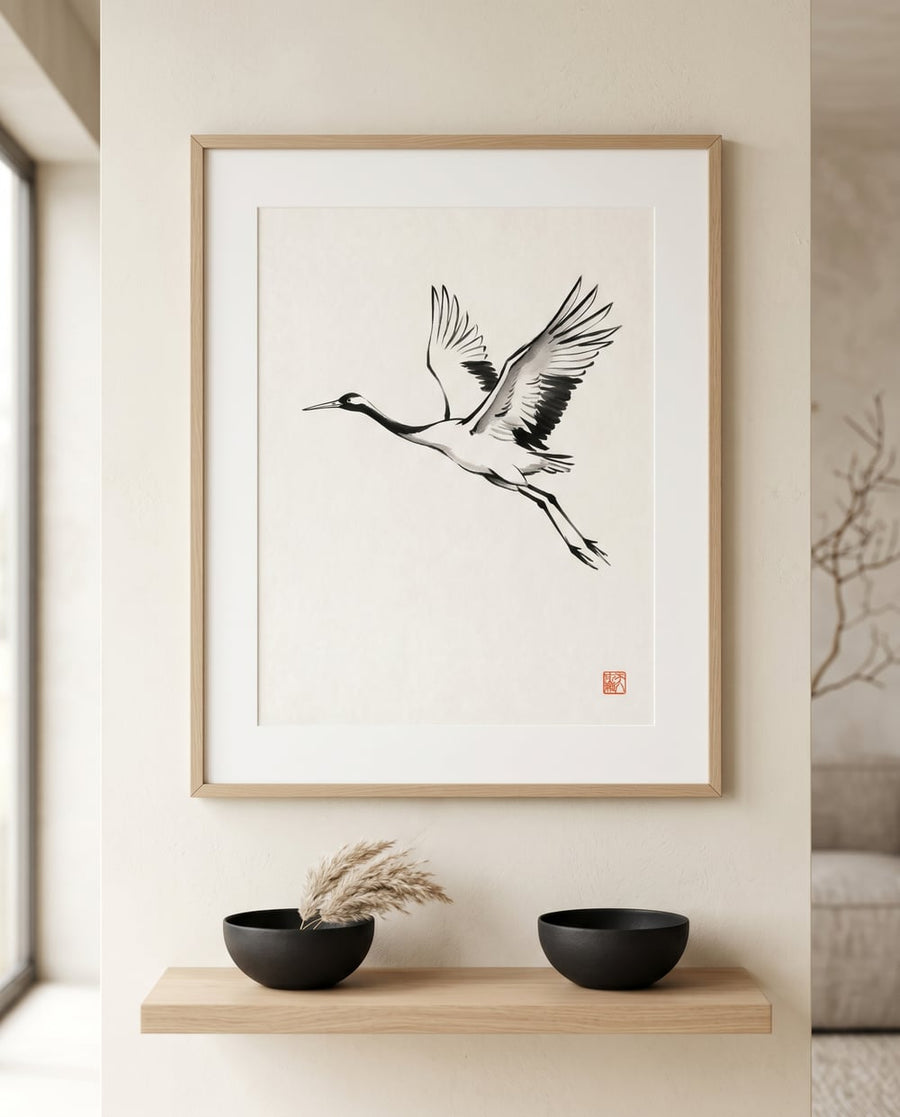
For a home rather than an occasion, think about the recipient's rooms. Someone who works from a small study will get more from plum; someone who has just finished a bedroom will get more from cherry. And if the person already loves Japanese motifs, a pairing with the crane makes sense: crane and plum are a traditional New Year combination, while crane and cherry is a spring pairing. Our guide to crane symbolism in Japanese art covers the bird's side of that conversation.
Two flowers, two moods
Cherry blossom vs plum blossom comes down to a notch in the petal and a difference in temperament. The plum flowers in the cold and stands for perseverance; the cherry flowers in the warmth and stands for the moment. Both are drawn on a bare branch, both are pink or white, and both belong in a quiet home.
Look at the petal tips, look at the stalks, and then ask which mood the room needs. The right answer is usually clearer than you expect.
Frequently asked questions
How can you tell cherry blossom from plum blossom in a painting?
Check the petal tips first: cherry petals have a small notch at the end, plum petals are smoothly rounded. Then look at how the flowers attach. Cherry blossoms hang in clusters on long stalks, while plum blossoms sit directly on the branch with almost no stem, often singly, on a dark and angular bough.
Which blooms first in Japan, plum or cherry?
Plum blooms first, usually from February into March, often while it is still cold. Cherry follows in late March and April, depending on the region, and its full bloom typically lasts only a week or two. This is why plum is associated with perseverance through winter and cherry with the brief arrival of spring.
Is cherry blossom or plum blossom better for a bedroom print?
Cherry blossom is the more restful choice for a bedroom. Its pale, drifting petals and its meaning, presence and renewal, suit a room for sleep. Plum blossom, with its darker branch and its associations with endurance and study, tends to work better in an office, a hallway or a dining room in winter.