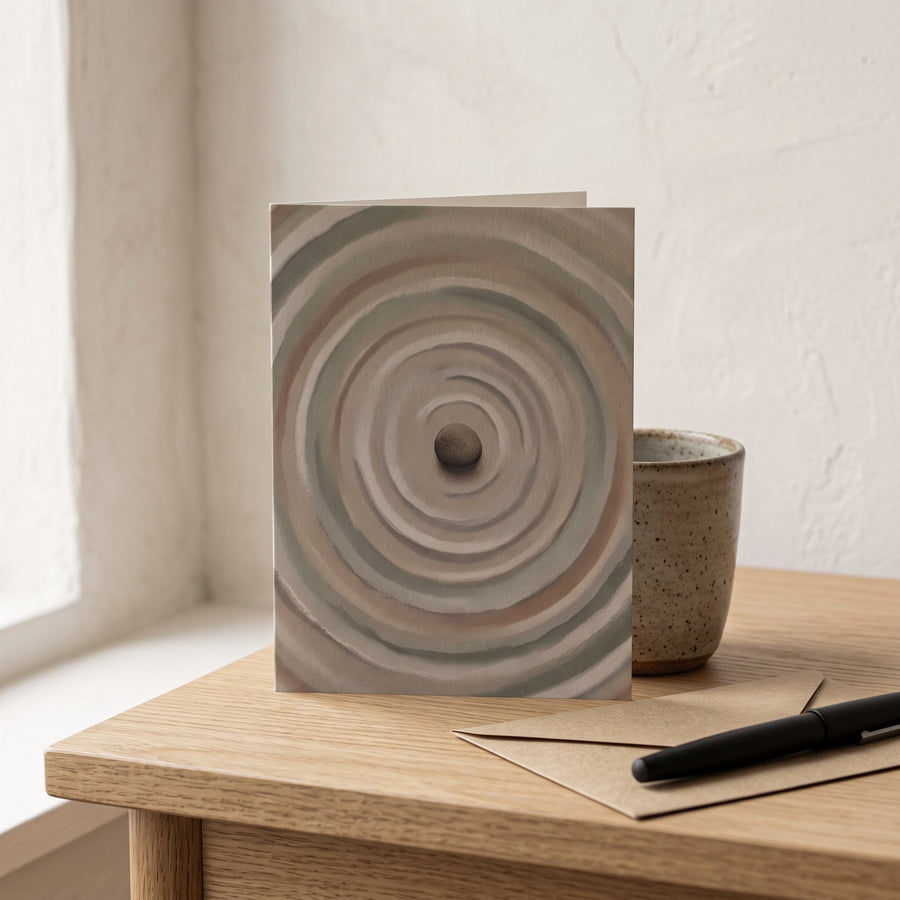
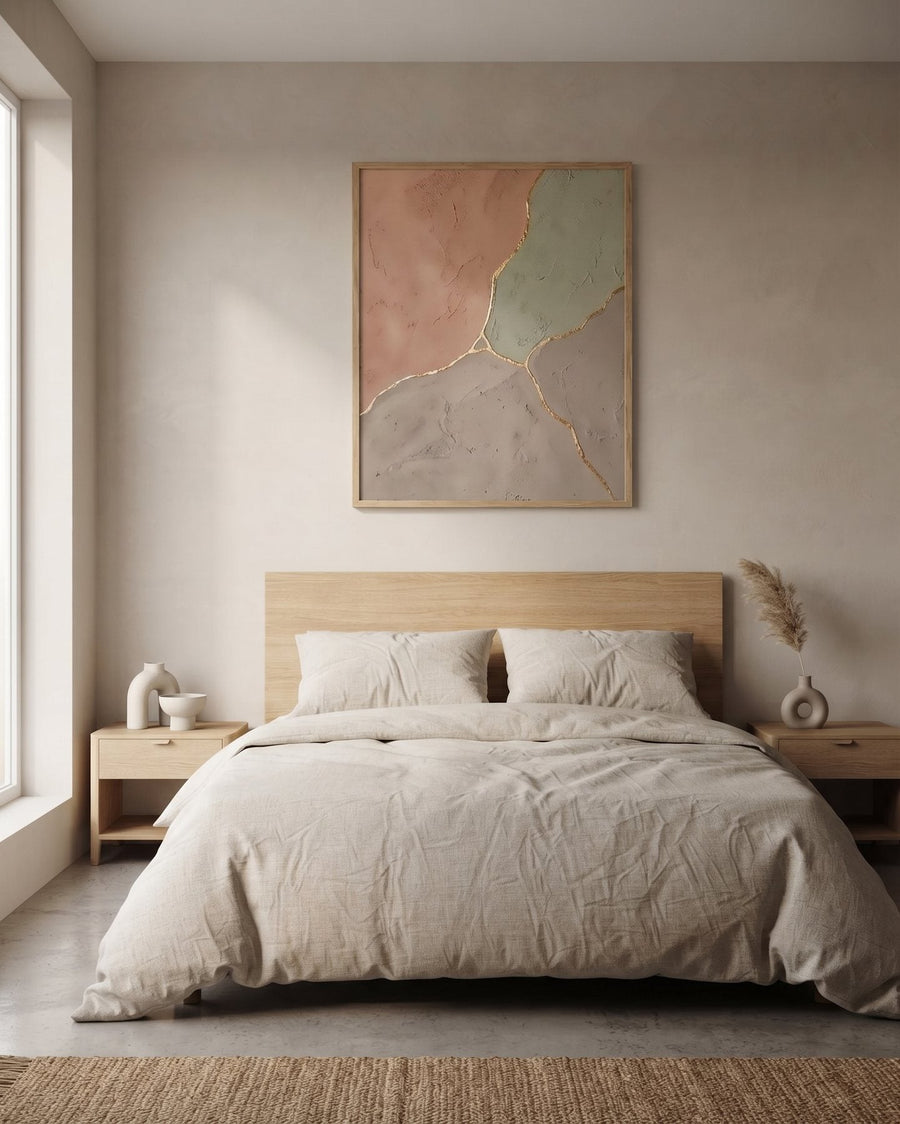
Wabi-sabi wall art is art that feels quiet, unfinished and close to nature: a few strokes of ink on paper, a single still pond, an uneven ensō circle, a weathered stone. It favours muted colour, visible brushwork and plenty of empty space, and it is usually hung simply, in a plain wooden frame or none at all. If a piece makes you slow down rather than look harder, it probably belongs.
What makes wall art wabi-sabi
Wabi-sabi is a Japanese way of seeing beauty in what is simple, imperfect and passing. Applied to art, it gives you a few reliable tests. Does the piece show the hand that made it? Does it leave room for the eye to rest? Does it feel as though it belongs to a season or a moment that will not last?
Wabi-sabi art rarely shouts. It tends to have a narrow palette of ink black, ash grey, clay, moss and paper white. The marks are often loose or broken, with dry-brush edges and drips left in place. And there is usually far more blank paper than image, because the emptiness is part of the composition rather than a gap to fill.
This is why so much wabi-sabi art comes from ink painting, ceramics and photography of natural textures. All three let accident and material speak. For the broader picture of how these ideas run through a home, our wabi-sabi decor guide is a good place to start.
Subjects that read as wabi-sabi
Some subjects carry the feeling of wabi-sabi almost by themselves. If you are choosing a first piece, these are a reliable place to look.
- Sumi-e ink painting. Black ink on paper, often a single branch, a bamboo stalk or a bird. Each stroke is made once and cannot be corrected, which is the essence of the style. Our guide what is sumi-e explains the technique and its history.
- The ensō. A single brushed circle, often left slightly open. It stands for completeness and imperfection at once, and it is perhaps the clearest symbol of wabi-sabi on paper. We look at it closely in the meaning of the ensō.
- Still water and mist. A pond, a lake at dawn, mountains fading into haze. Landscapes with soft edges and lots of sky feel calm and spacious.
- Single stems and seed heads. One grass, one flower past its best, one dried pod. Botanical subjects in decline are a gentle reminder of impermanence.
- Still life of humble objects. A cracked bowl, a teacup, a stone. Ordinary things painted or photographed with care, often in low light.
- Abstract texture. Washes of ink, close-ups of clay, weathered wood or rusted metal. These work well in pairs or as a quiet companion to a figurative piece.
Colour, paper and texture
The material of a print matters as much as the image. A wabi-sabi piece printed on bright, glossy paper loses much of its softness. Look instead for matte papers with a slight tooth, in a warm white or natural tone, so the ink appears to sit in the fibres rather than on top of them.
Keep colour restrained. Most wabi-sabi art works in black and grey with a single earth tone, such as rust, ochre or sage. If the rest of the room is already neutral, one piece with a soft wash of colour will feel warm without breaking the mood.
Framing wabi-sabi wall art bare
The frame should disappear. Ornate mouldings, gilt and heavy black profiles all compete with a delicate ink drawing. The wabi-sabi approach is to frame simply or barely at all.
Plain wood, thin profile
A slim frame in natural oak, ash or a soft walnut suits almost any wabi-sabi piece. The grain adds warmth and texture without drawing attention. Choose a matte finish over lacquer.
A wide, quiet mount
A generous mount in warm white or off-white gives the image room to breathe and echoes the empty space within it. A mount that is wider at the bottom than the top is a traditional touch that makes the image feel properly placed.
Or no frame at all
Small works on paper can be pinned with brass tacks, clipped to a wooden hanger or simply leaned on a shelf or ledge. A greeting card propped against the wall behind a bowl is a perfectly valid piece of wabi-sabi wall art. Our guide on how to frame art prints covers measurements and mounting in detail.
Where to hang it and how much to use
Wabi-sabi wall art needs space around it. One piece on a large wall almost always looks better than a crowded gallery. If you love the idea of a group, keep it to two or three works with consistent frames and wide gaps, and let one piece lead.
Hang the centre of the artwork at roughly eye height, around 145 to 155 cm from the floor, or lower when it sits above a sofa, sideboard or bed, so it relates to the furniture beneath. Leaving a clear wall beside it is as important as the piece itself; our essay on the art of negative space explains why.
Think about light, too. Ink and soft washes look their best in indirect daylight or the low, warm light of a lamp at evening. Avoid placing delicate prints where strong sun will fall on them for hours, which can fade paper over time.
- Living room: one larger ink landscape above the sofa, or a pair of tall narrow prints either side of a window.
- Bedroom: a single quiet piece above the bed, ideally a still pond or misty landscape. Keep the bedside surfaces just as spare.
- Hallway: a small ensō or single stem at eye height, where you will pass it many times a day.
Choosing art that will last
Wabi-sabi wall art is not a trend to refresh every year. Choose pieces you can imagine living with for a long time, and let them settle into the room. Over time the paper may warm slightly, the frame will pick up the marks of being moved, and the work will feel more yours.
Start with one piece you genuinely love, give it a wall to itself and live with it for a season before adding anything else. That patience is the heart of wabi-sabi.
Frequently asked questions
What kind of art is wabi-sabi?
Art that is simple, imperfect and close to nature. Sumi-e ink painting, ensō circles, misty landscapes, single botanical stems and still lifes of humble objects are common examples. The work tends to use muted colour, visible brushwork and plenty of empty space.
Should wabi-sabi art be framed?
It can be framed or left bare. If you frame it, choose a thin, natural wood frame with a wide off-white mount. Unframed works on paper can be pinned, clipped to a wooden hanger or leaned on a shelf.
Is Japandi wall art the same as wabi-sabi wall art?
They overlap a great deal. Japandi art leans towards clean lines and graphic minimalism, while wabi-sabi art leans further into texture, irregularity and the marks of age. Many homes happily borrow from both.