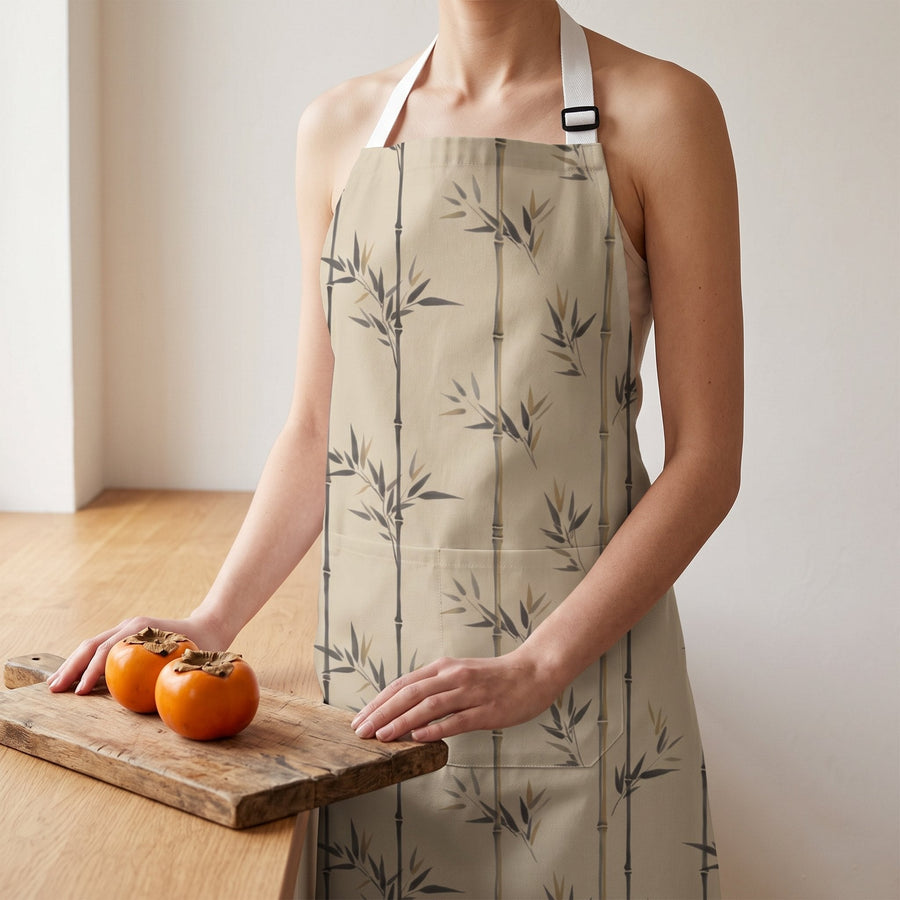
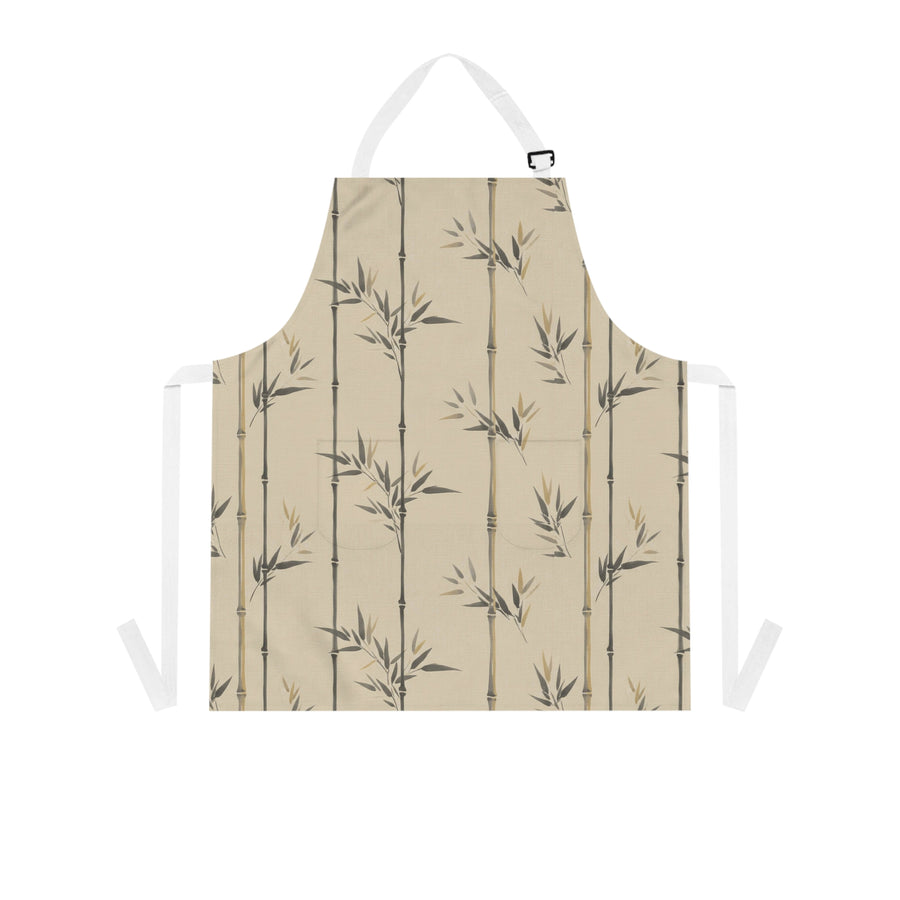
A japandi apron is the one kitchen textile that earns its place on a hook by being worn rather than stored. The right one is cut from a mid-weight cotton twill or a linen-look cloth, has ties long enough to knot at the front, a single deep pocket, and a print quiet enough that you reach for it every day. Everything else is detail, and the details are what this guide is about.
We make aprons in our Copenhagen studio because we kept borrowing the same tired one from the back of the kitchen door. It had lost its shape, the neck strap was too short, and the pattern was loud enough to argue with the tea towels. That apron taught us what to change.
Why an apron belongs in a quiet kitchen
Most people think of an apron as protection, and it is. But its real job in a calm home is ritual. Tying one on marks the start of cooking the way lighting a lamp marks the start of evening. It slows you down by a few seconds and tells the rest of the house that something is being made.
A quiet kitchen also depends on a small number of well-chosen objects doing several jobs at once. An apron that hangs well enough to stay on show is a textile, a note of colour and a working tool in one. That is the kind of thing worth buying carefully, and only once. Our guide to a slow Sunday morning kitchen works on the same principle.
Cotton twill or linen: choosing the cloth
The two fabrics you will meet most often are cotton twill and linen, or a linen-look cotton blend. Neither is wrong. They suit different cooks.
Cotton twill
Twill is woven on a diagonal, which gives it a faint sheen and a firm hand. A mid-weight twill, somewhere around 250 to 300 grams per square metre, hangs straight, holds a splash on the surface for a moment before it soaks in, and takes a hot wash without complaint. It is the practical choice for someone who cooks most nights and wants a fabric that looks tidy even when it has not been ironed.
Linen and linen-look
Linen is cooler against the skin, softens with every wash and creases in a way that reads as relaxed rather than untidy. It is the more Japandi of the two, if such a thing can be said, because it looks like exactly what it is. The trade-off is that pure linen is lighter and moves more, so a real linen apron can feel less like armour at the stove. A linen-look blend gives you most of the texture with a little more body; we compare the two honestly in our guide to linen-look versus real linen.
If you are torn, ask where the apron will live. On a hook by the cooker, twill. Draped over a chair and worn for a long, slow bake, linen.
Ties, straps and the fit that keeps you wearing it
An apron you have to adjust every time you put it on is an apron you will stop putting on. Three details decide the fit.
- The neck strap. A fixed strap is simpler and lies flatter, but only if it is the right length for you. An adjustable strap with a slider or a pair of eyelets suits a shared kitchen where two people of different heights cook.
- The waist ties. Look for ties long enough to cross behind and knot at the front, roughly 90 centimetres each side. A front knot is easier to undo with wet hands and lets you tuck a towel through it.
- The bib width. A bib around 30 centimetres wide covers the chest without cutting into the arms. Narrower looks elegant on a hanger and leaves your jumper exposed to the sauce.
Length matters too. A full apron that finishes just above the knee protects trousers from flour and oil; a shorter waist apron is better for serving than for cooking. Most people want the former.
Pockets: one, deep, in the middle
We have tried aprons with no pockets, with two chest pockets, and with a row of little slots for pens. The version that survives daily use has a single wide pocket at the hip, split in two by a line of stitching. It holds a phone, a thermometer and a scrap of paper with the recipe on it, and it does not gape when you bend.
A chest pocket is charming and almost never used, except to catch crumbs. If a design has one, that is fine, but do not choose an apron because of it.
Print, colour and the pattern question
This is where most aprons go wrong. A busy print made sense when aprons were meant to hide stains, but a japandi kitchen runs on restraint. The apron should sit within the room's palette rather than announce itself. In practice that means one of three approaches.
- Plain, in a warm neutral. Undyed linen, oat, stone or a soft grey. It goes with everything and lets the stains become part of the story.
- A single motif, generously spaced. A sumi-e branch or an ensō placed once, low on the bib, gives the apron a point of view without turning it into a poster.
- A quiet all-over pattern. Small-scale botanicals or a loose ink wash in one or two tones read as texture from across the room. Keep the ground colour close to your walls and it will disappear in the best way.
Choose the print as you would choose a rug or a cushion, with the whole room in mind. Our note on the Japandi colour palette is a useful check before you commit. If the apron would clash with the tea towels, it will clash with everything.
Caring for an apron so it lasts for years
An apron is washed more often than almost any other textile in the house, so its care routine decides its lifespan. Wash at 40 degrees with similar colours and skip the fabric softener, which coats the fibres and makes them less absorbent. Tumble dry low or, better, hang it on the line by the neck strap so the weight of the cloth pulls out most of the creases.
Oil stains want a little washing-up liquid rubbed into the spot before the wash. Turmeric and beetroot are best rinsed in cold water straight away, then left in sunlight, which fades them more gently than bleach. Iron twill while it is slightly damp; leave linen alone unless you want it crisp. Our linen care guide goes into the finer points.
If the ties fray after a few years, they can be trimmed and re-hemmed in ten minutes. A good apron is worth that.
Worn, not stored
The test of a japandi apron is simple: does it come off the hook every day? A cloth that feels good, ties that do not need fiddling with, a pocket that holds what you need and a print that belongs in the room will pass it. Anything else is a gift that lives in a drawer.
Buy one, wear it until it softens, and hang it where you can see it. Then, if you like, choose tea towels that speak the same language, and the kitchen will start to feel finished.
Worth considering
A few well-made pieces we would happily put next to our own. These are Amazon links; as an Amazon Associate we earn from qualifying purchases, at no cost to you.
- Wooden wall hooks, set of three — An apron that hangs by the cooker gets worn; a plain wooden hook is all it needs.
- Stoneware utensil crock with beech utensils — A jar of wooden spoons within reach of the stove, in the same unfussy materials as a good apron.
- Acacia-wood tray with cut-out handles, 17″ — Gathers the oil, salt and the recipe card into one place while you cook.
Frequently asked questions
What fabric is best for a kitchen apron?
Mid-weight cotton twill is the most practical for daily cooking because it hangs straight, holds off light splashes and survives hot washes. Linen or a linen-look blend is softer and cooler and suits slower cooking and warmer kitchens. Avoid thin poly-cotton, which stains easily and never feels quite right.
Should an apron have a cross-back or a neck strap?
A neck strap is quicker to put on and works for most people, especially if it is adjustable. A cross-back apron spreads the weight across the shoulders and is worth considering if you cook for long stretches or find neck straps uncomfortable. Both styles work with a front-tying waist.
How do I keep an apron from looking worn out?
Wash it at 40 degrees without softener, treat oil stains before washing, and line dry it by the neck strap. Trim and re-hem the ties if they fray. A natural-fibre apron cared for this way will soften rather than sag, and most stains fade into character.