Moon phases art shows the moon's cycle from new to full and back again, usually as a row or column of circles, and its meaning is the cycle itself: change, return and the acceptance that nothing stays full for long. It is one of the few minimalist motifs that carries a clear message without a single word or figure, which is why it has become a staple above beds, on landing walls and on small objects like coasters and cards.
This guide explains what the phases mean, where the motif comes from in Japanese art, and the practical choice most people get wrong: whether to hang the cycle horizontally or vertically.
What moon phases art means
The moon takes about twenty-nine and a half days to move from new moon through the waxing crescent, first quarter and waxing gibbous to full, then back through the waning gibbous, last quarter and waning crescent to new again. A print of the phases is a picture of that month compressed into a line. Read left to right it is a story with a beginning, a peak and a quiet ending, and then, because the last circle is dark like the first, it starts again.
That circularity is the point. The phases are used to mean:
- Impermanence. The full moon lasts one night. In Japanese aesthetics this is the same idea that gives cherry blossom its weight: the beautiful thing is beautiful partly because it passes.
- Return. The waning moon is not an ending. Every dark phase is followed by a sliver of light, which makes the motif a gentle emblem of recovery and of patience through a low period.
- Rhythm. Sleep, tides, seasons and the working month all run in cycles. A row of phases on a bedroom wall is a quiet reminder that rest is part of the pattern rather than a pause in it.
- Balance. The waxing and waning halves mirror each other. In a room the motif reads as symmetrical and settled even when the individual moons are drawn loosely.
The moon in Japanese art
Japan has a long tradition of looking at the moon on purpose. Tsukimi, moon viewing, is held on the fifteenth night of the eighth lunar month, in September or October, when the harvest moon is at its clearest; people set out pampas grass and rice dumplings and simply watch it rise. Poetry from the earliest collections is full of the moon seen through pine branches, over water or from a veranda, and the reflected moon in a pond or a cup of sake is a recurring image of something you can see but not hold.
Ink painters tended to draw the moon by leaving it out. A circle of untouched paper against a wash of grey is the full moon; a crescent is a single curved stroke with the rest of the disc implied. That approach, where the brightest thing in the picture is the blank, is the reason moon motifs suit the Japandi palette so well. It is also the same logic behind the ensō, the one-stroke circle, and our guide to the meaning of the ensō is worth reading alongside this one; the two circles are cousins.
Horizontal or vertical: choosing the format
Most moon phases art comes in two formats, a horizontal row or a vertical column, and the choice affects both the meaning and where the piece can go.
The horizontal row
A row of phases reads like a timeline. The eye moves left to right, the moon grows and shrinks, and the piece feels calm and orderly. Horizontal formats suit wide walls and low furniture: above a sofa, above a long sideboard, above a bed with a low headboard. They also suit a landscape-orientated space, because the line of moons echoes the horizon. If the wall above your bed is wider than it is tall, this is the format to choose; our guide to art above the bed gives the widths to aim for.
The vertical column
A column of phases reads like the moon rising and setting rather than the month passing. It has more energy, and it draws the eye up, which makes a room feel taller. Vertical formats work beside a doorway, in a narrow alcove, on a stair wall or on the slice of wall between two windows. A pair of vertical moon prints either side of a bed is a classic Japandi arrangement, particularly with the phases running in opposite directions so the two columns mirror each other.
The single moon
There is a third option: one moon, usually full or crescent, on its own. It is less of a diagram and more of a mood. A single full moon above a bed is quiet to the point of stillness; a lone crescent is more wistful. If the full cycle feels too busy for the room, one moon carries most of the meaning at a fraction of the visual weight.
Colour and material
Moon phases art is at its best in the smallest palette. Ink on warm white paper, white on charcoal, or unglazed clay against a dark ground all work; full-colour night skies rarely do, because the stars and gradients compete with the circles. In a room with warm neutral walls, a black-ink moon cycle sits comfortably with oak and linen. In a darker room, a pale moon cycle on a deep ground becomes the one point of light, an effect we describe in our piece on dark Japandi.
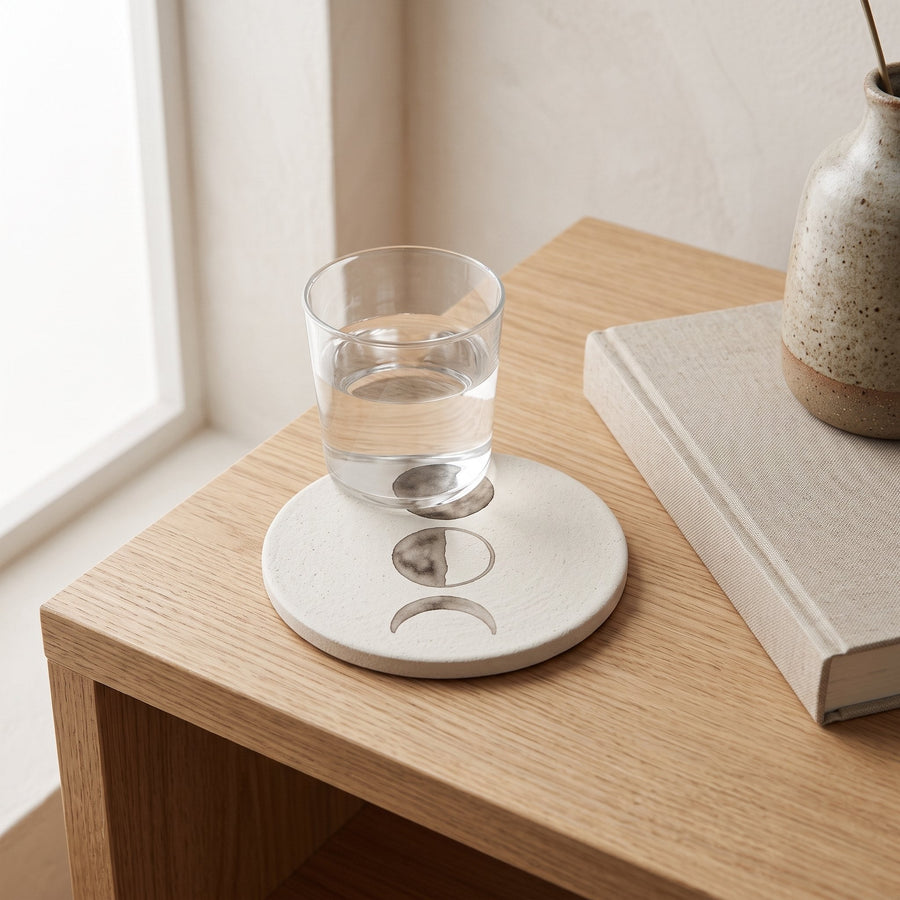
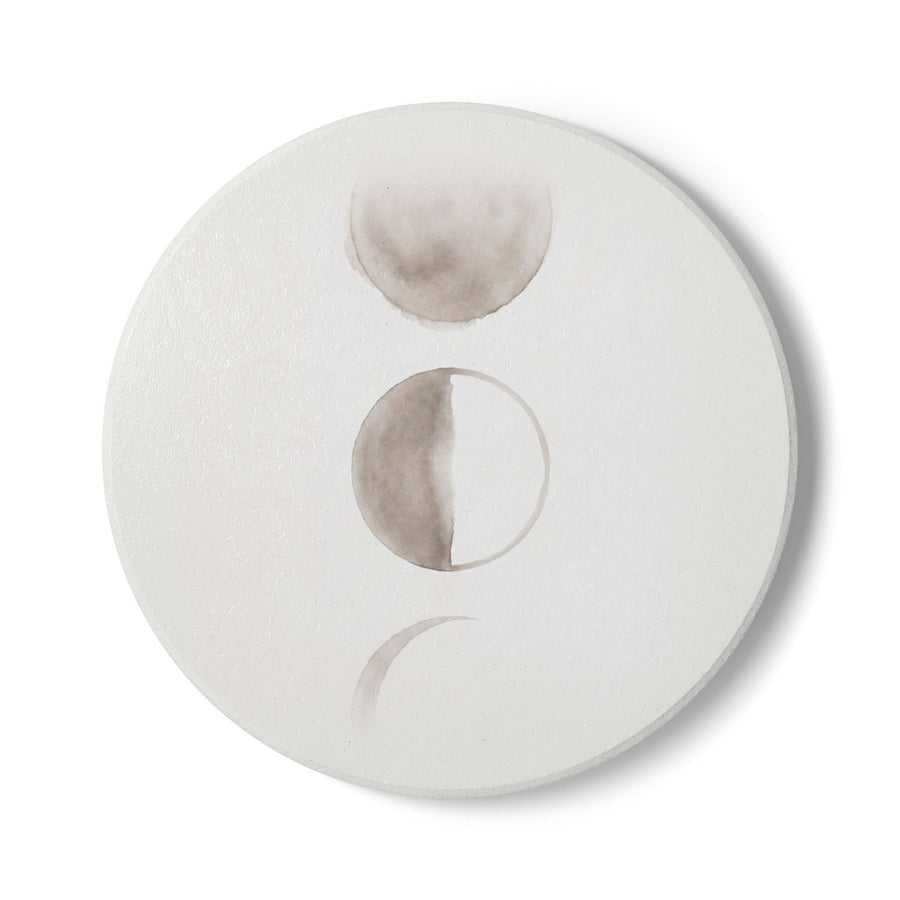
The motif also translates well into objects. Engraved into stoneware, the phases become a ring of moons around a coaster; embossed on card they catch raking light in the evening. Because the shape is so simple, it survives being small. A moon coaster under a mug on the nightstand is often all the moon a bedroom needs, and our nightstand styling guide shows how few objects that surface can hold.
Placing moon phases art in the home
The bedroom is the obvious home for the motif, and it is the right one: the moon is the night's emblem, and the cycle's message of rest and return suits the room. Hang a horizontal cycle above the bed at roughly the width of the headboard, or a single vertical column on the wall you face on waking. Keep the frame slim and the mount wide, so the circles float.
Beyond the bedroom, the motif works in a landing or stairwell, where a vertical column uses the height, and in a home office, where a row of phases is a small reminder that work has cycles too. The one place we would avoid is a bright, busy kitchen, where the quietness of the piece gets lost. If you are lighting a room for the evening, a moon print catches lamplight beautifully; our guide to lighting the five o'clock room covers where to put that lamp.
A month on the wall
Moon phases art works because it is honest about time. It shows the full moon and the dark one with the same weight, and it puts the whole cycle in a single line you can take in at a glance. That is a rare thing for a decorative object to do.
Choose the format that suits the wall, keep the palette to two tones, and let the circles have their space. The moon has never needed a frame to be looked at, but a good one helps.
Frequently asked questions
What do the moon phases symbolise in art?
The phases symbolise cycles: change, impermanence and return. The full moon represents completeness and the dark new moon a beginning, and the waxing and waning halves stand for growth and release. In Japanese art the moon is also linked to autumn moon viewing, to reflection and to the beauty of things that pass.
Should moon phase art be hung horizontally or vertically?
Hang it horizontally above wide, low furniture such as a bed or sofa, where the row of moons echoes the horizon and reads like a calendar. Hang it vertically in a narrow space, beside a door, on a stair wall or as a pair either side of a bed, where the column draws the eye upward and makes the wall feel taller.
Is moon phases art suitable for a bedroom?
Yes, it is one of the most fitting motifs for a bedroom. The moon is the emblem of night and rest, and the cycle's message of rhythm and return suits a room for sleep. Choose a two-tone version, ink on white or pale on dark, and hang it above the bed or on the wall you see first in the morning.