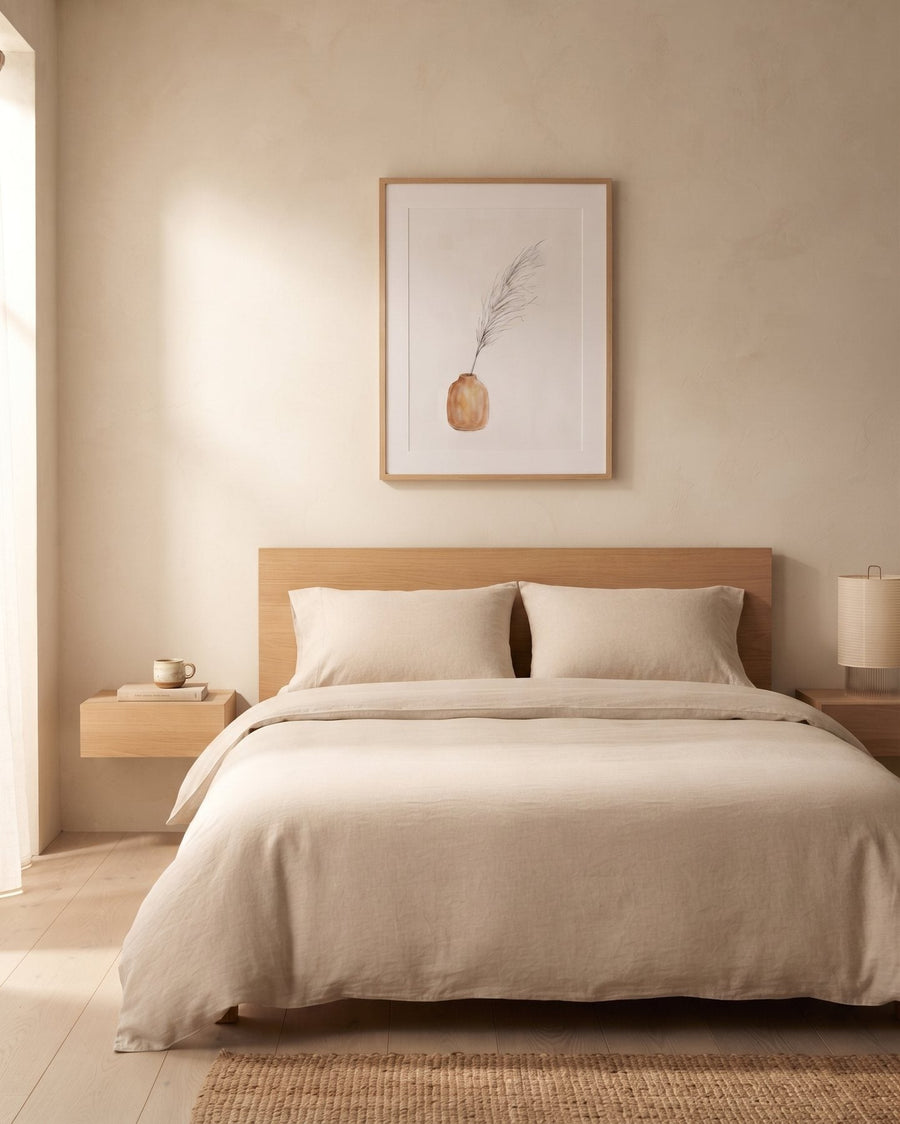
The right art above bed size is between 60 and 75 percent of the bed's width, frame included, hung so the bottom edge sits 15 to 25 cm above the top of the mattress or headboard. For a 160 cm double that means a piece roughly 100 to 120 cm wide; for a 180 cm king, 110 to 135 cm. Those two numbers, width and height, settle most of the decision.
The rest of this guide is about the choices around them: whether to hang one piece or a pair, how the numbers shift with a headboard, and which subjects are restful enough to sleep under. It ends with the short list of things not to hang above a bed.
Width: the 60 to 75 percent rule
Art above a bed is measured against the bed, not the wall. A piece that fills the wall will loom; a piece that fills a fraction of the bed's width will float. Somewhere between two-thirds and three-quarters of the bed is where it looks anchored, and the exact point depends on how much else is on the wall.
Go towards 60 percent if there are two lamps or two nightstands that already frame the bed visually. Go towards 75 percent if the wall is otherwise bare and the bed has no headboard. The principle is the same one we set out in the 30-30-30 rule: the art, the bed and the space around them should feel like three parts of one composition.
By bed size
- Single, 90 cm: a piece 55 to 70 cm wide. A single A1 print in a frame lands here.
- Small double, 120 cm: 70 to 90 cm wide.
- Double, 135 to 140 cm: 80 to 105 cm wide.
- King, 150 to 160 cm: 90 to 120 cm wide. A pair of 50 x 70 cm frames side by side sits neatly in this range.
- Super king, 180 cm: 110 to 135 cm wide. A pair of 60 x 80 cm frames, or one wide landscape print.
These widths include the frame and any mount, so measure the finished piece rather than the paper. If you are unsure how paper sizes translate to framed sizes, our guide to art print sizes lays it out.
Height: where the bottom edge goes
The usual advice to hang art at eye level does not apply above a bed, because nobody stands there. Instead, the art is measured from what is beneath it.
With no headboard, hang the piece so its bottom edge sits 15 to 25 cm above the top of the made bed, pillows included. With a headboard, measure from the top of the headboard instead, and use the smaller end of that range so the art and the headboard read as one stacked shape rather than two separate ones.
The centre of the piece will usually land somewhere between 140 and 160 cm from the floor, which is a little higher than the gallery standard. That is fine. Above a bed the art belongs to the bed, and it should sit close to it.
One piece or a pair
A single wide piece is the calmest choice, and it suits a landscape format naturally. A pair works when the room is already symmetrical, with two nightstands and two lamps, because the two frames continue that rhythm up the wall.
If you hang a pair, treat it as one object. Same size, same frame, same mount, with a gap of 5 to 8 cm between them and their combined width inside the 60 to 75 percent range. The subjects should belong together without being the same: a crane rising and a crane at rest, two views of one branch, two phases of a moon. Our guide to framing prints covers matching mounts so the pair reads as a set.
Three or more pieces above a bed is a gallery wall, and while it can work in a living room, in a bedroom it rarely rests. If you want more than two, keep them very small and very close, so the group reads as a single shape.
Subjects that sleep well
The bedroom is the one room where art should ask nothing of you. That rules out most of what works elsewhere: strong contrast, saturated colour, faces, text, anything with a joke in it. What remains is quieter and, above a bed, better.
- A single branch or stem in ink. A cherry or plum branch drawn with generous space around it, or a single stem in a bottle. Our note on the single stem rule explains why one gesture is enough.
- A misted landscape. Mountains fading into paper, a still pond, a horizon line. Horizontal formats echo the bed's own shape.
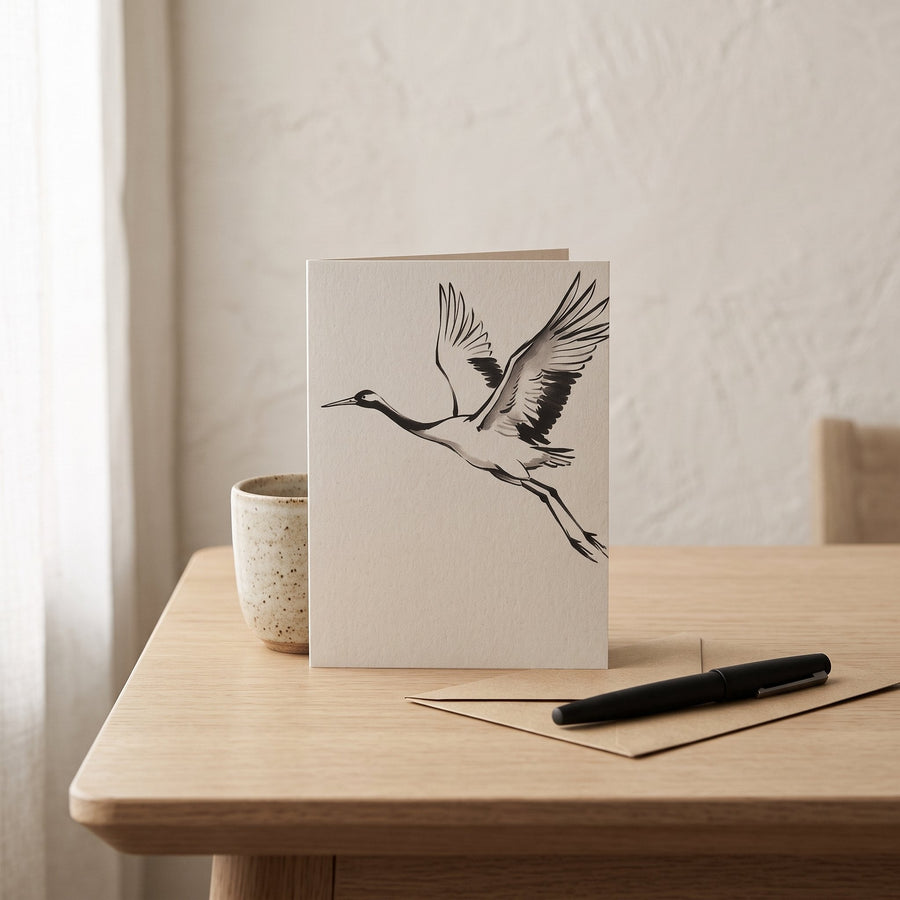
- A bird in flight. A crane in a few brushstrokes has become the bedroom print we are asked about most, partly for the way it looks and partly for what it means; we wrote about that in our piece on crane symbolism in Japanese art.
- A moon or an enso. One circle, a great deal of paper. As near to nothing as art gets, and often the best choice above a low bed.
Keep the palette close to the room: ink on natural paper for a warm white bedroom, a soft indigo for a grey one, a single rust or clay tone for a room with a wool throw in the same family.
What not to hang above a bed
A few things reliably undo a bedroom, however well they are sized and hung.
Glass without a frame or with a thin one, in a heavy piece. Above a bed, a large glazed frame is a weight question before it is a style one. Use acrylic glazing for anything over 60 cm across, and fix it into the wall with two hooks rather than one nail.
Mirrors. A mirror above a bed reflects the ceiling light straight into your eyes and adds a hard, cold plane to the softest room in the house. Put it on the wardrobe door instead.
Anything that says something. Words, slogans, a print that makes a point. You will read it every night. Shelves above the bed fall into the same category for a different reason: they put objects at head height and give you something to knock.
And anything you are not sure of. If you are between two pieces, hang the quieter one. The other can go in the hall.
Hanging it once
Measure the bed's width and take 60 to 75 percent of it. Measure from the top of the made bed or the headboard and add 15 to 25 cm. Mark the wall in pencil, hold the piece up with a second pair of hands, and step to the door before committing. If the art, the bed and the wall look like one thought, it is right.
Choose a subject that asks nothing of you, in a colour close to the room's, and fix it well. Art above a bed is the last thing you see at night and the first thing in the morning; it should earn that place by being calm.
Frequently asked questions
How big should a picture be above a king size bed?
For a 150 to 160 cm king, a piece 90 to 120 cm wide including the frame. For a 180 cm super king, 110 to 135 cm. A pair of 50 x 70 cm or 60 x 80 cm frames hung 5 to 8 cm apart lands in these ranges and suits a bed with two nightstands.
How high should art be hung above a headboard?
Leave 15 to 20 cm between the top of the headboard and the bottom of the frame, so the two read as one stacked shape. Without a headboard, measure from the top of the made bed and leave 15 to 25 cm. The centre of the piece usually ends up around 140 to 160 cm from the floor.
Is it bad to hang heavy art above a bed?
It is a weight question rather than a style one. Use acrylic glazing instead of glass for anything wider than about 60 cm, hang from two fixings rather than one, and choose wall plugs rated for the frame's weight. Mirrors and shelves above a bed are better avoided altogether.