Small Japandi bedroom storage works by disappearing: under the bed, on the wall as hooks, and inside one wardrobe that holds everything and shows nothing. Three places, no freestanding units, no baskets on display. If a storage solution is visible from the bed, it is furniture, and a small bedroom has room for very little furniture.
This guide is about those three places and the one rule that ties them together. It is written for a room where the bed takes most of the floor and the door only just clears it, because that is the room most people are asking about.
The principle: storage you cannot see from the pillow
Japandi rooms rely on open floor and bare wall to feel calm, and a small bedroom has less of both to spare. Every chest of drawers, every open shelf, every basket of folded jumpers takes a share of the little there is. The aim is not to have less stuff, though that helps, but to have every piece of it in a place the eye does not land on.
The test is simple. Lie on the bed and look around. Anything you can see that is storing something has failed. We wrote about this at length in storage that doesn't look like storage; the small bedroom is where that idea earns its keep.
Under the bed
The largest unused volume in most small bedrooms is beneath the mattress. A platform bed at 45 to 55 cm leaves a drawer's depth of space below; even a low bed on 15 cm legs will take flat boxes. This is where the bulk goes: out-of-season clothes, spare bedding, the suitcase.
Three ways to use it, from most to least built-in:
- A bed with integrated drawers. Two long drawers on runners, opening to the side or the foot. Choose a frame where the drawer fronts are flush and the same wood as the frame, so the bed reads as a solid block. Avoid drawers on the side the door opens onto.
- An ottoman or lift-up base. The whole mattress platform hinges up on gas struts. It holds more than drawers, keeps dust out, and needs no clearance on any side, which suits a bed pushed into a corner.
- Flat boxes under a plain frame. The cheapest route. Choose lidded boxes in a single colour, ideally fabric or unbleached card rather than clear plastic, and a bed with a valance or a low rail that hides them. If the boxes can be seen, they count as visible storage.
If you are choosing a bed now, the storage question and the height question go together; our guide to low beds versus platform beds weighs them against each other.
On the wall: hooks, not shelves
Shelves in a small bedroom fill up. Hooks do not, because a hook holds one thing and makes it obvious when it holds two. A short row of three or four wooden pegs on a rail, at about 165 cm from the floor, takes a dressing gown, tomorrow's shirt and a bag, and it makes the wall look furnished rather than cluttered.
Keep the pegs in the same wood as the bed and mount the rail on the wall you see least from the pillow, usually the one beside or behind the door. One rail. A second rail on another wall is a cloakroom.
A single wall-mounted nightstand, a small shelf or a floating drawer beside the bed, replaces a freestanding one and keeps the floor clear beneath it. Lamp, book, glass, and nothing else. Even the nightstand should look like it is not storing anything.
The one-wardrobe rule
Everything that is not under the bed or on a hook lives in one wardrobe, and the wardrobe is the only tall object in the room. Not a wardrobe and a chest of drawers. Not a wardrobe and a bookcase. One.
That means the wardrobe has to work harder than usual. Go floor to ceiling if you can, in a plain door with no handles or with the smallest pull you can find, in a colour close to the wall so it reads as a wall rather than a cupboard. Inside, fit it out fully: a rail at the top, shelves below, a drawer or two at the bottom, and boxes on the top shelf for the things you touch twice a year.
What goes where inside it
- Top shelf: lidded boxes with spare towels, the winter duvet, things kept rather than used.
- Rail: only what hangs well. Shirts, dresses, coats. Everything else folds.
- Shelves: folded knitwear and trousers in single stacks no taller than a forearm, so each stack can be seen at a glance.
- Bottom: shoes in a row or a drawer, a laundry bag, and nothing on the floor of the wardrobe that is not one of those.
The wardrobe is also where the edit happens. A single wardrobe holds a real quantity of clothes if the clothes are the ones you wear; our note on the quiet wardrobe is about getting to that point without turning it into a project.
Small moves that free a lot of floor
A few adjustments cost little and give back more than they take.
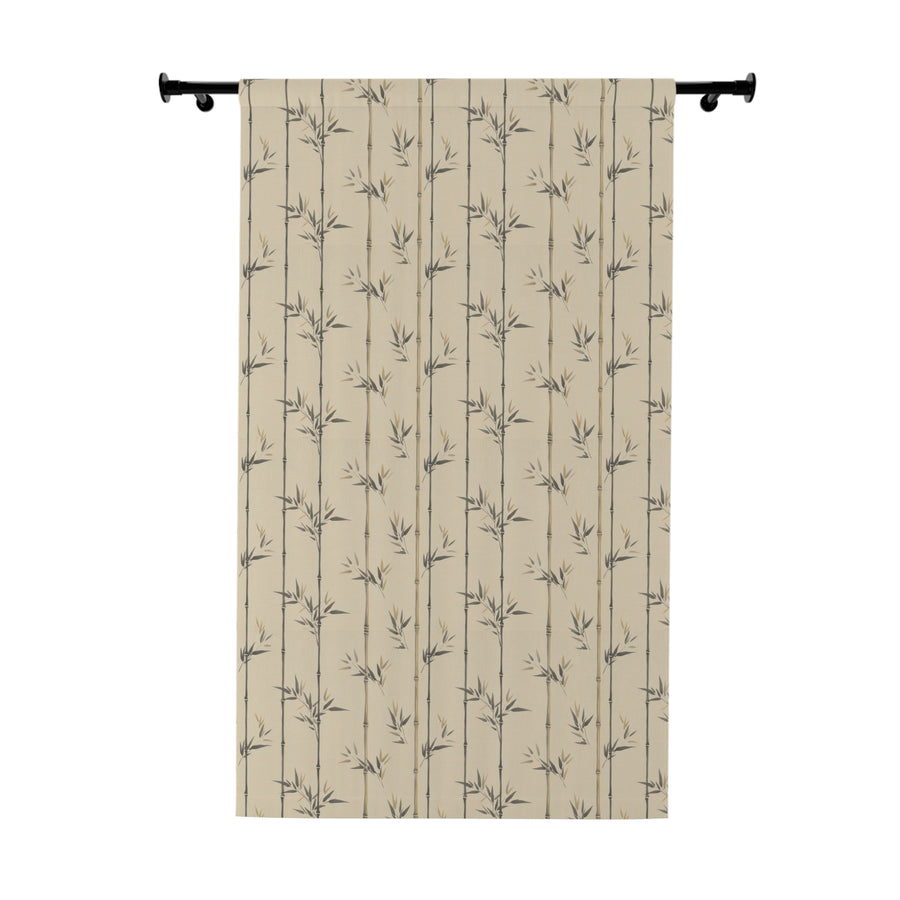
Hang the curtain rod close to the ceiling and let the panel fall to the floor. The room looks taller and the window wall stops feeling crowded; our guide to Japandi bedroom curtains covers lengths and rod placement.
Put the mirror on the inside of the wardrobe door. A freestanding mirror is a piece of furniture; a mirror on a door is free.
Use a bench at the foot of the bed only if the bench has storage inside it and only if there is room to walk round it. Otherwise it is a place for clothes to gather. Our small bedroom on a budget piece shows a full room done this way, without a single visible box.
A room with nothing in it but a bed
Done well, small Japandi bedroom storage leaves a room that appears to hold a bed, a wardrobe that looks like a wall, a rail of pegs and a lamp. Everything you own is in it. None of it is on show.
Under the bed for bulk, hooks for the daily things, one wardrobe for the rest. Keep to those three, resist the fourth, and a small bedroom can be as calm as a large one, and quicker to keep that way.
Worth considering
A few well-made pieces we would happily put next to our own. These are Amazon links; as an Amazon Associate we earn from qualifying purchases, at no cost to you.
- Wooden wall hooks, set of three — Hooks rather than shelves: each one holds a single thing and cannot quietly fill up.
- Fabric hanging wardrobe organiser, six shelves — Turns one hanging rail into folded storage, so the one wardrobe can take what a chest of drawers used to.
- Linen storage cubes, set of three — For inside the wardrobe, not on display: they keep smaller things sorted behind the door.
- Bamboo expandable drawer dividers, set of four — Order inside an under-bed drawer, where nobody sees it but you.
Frequently asked questions
How do you store clothes in a small bedroom with no closet?
Buy or build one tall wardrobe, floor to ceiling if the room allows, in a plain door close to the wall colour, and fit it out fully with a rail, shelves and boxes. Put out-of-season clothes in drawers or boxes under the bed and daily items on a short rail of pegs. That combination replaces a chest of drawers and keeps the floor clear.
Is under-bed storage a good idea?
Yes, provided it cannot be seen. A bed with flush integrated drawers or a lift-up ottoman base hides everything and keeps dust out. If you use boxes under a plain frame, choose lidded boxes in a single colour and a bed with a low rail or valance that conceals them. Visible boxes under a bed are clutter, not storage.
What furniture should a small Japandi bedroom have?
A bed, one wardrobe, a lamp and a small nightstand, ideally wall-mounted. A row of wall pegs takes the place of a chair for clothes. Avoid a second tall unit, open shelving and freestanding mirrors; each takes floor or wall the room cannot spare.