A Japandi office for two works when it follows one of two layouts, symmetry or zones, and when both halves share a single palette and plenty of soft textiles to absorb sound. Symmetry suits couples with similar work habits; zones suit people who take calls at different times or need different setups. Either way, the room stays calm because it looks like one considered space rather than two desks pushed together.
This guide walks through both layouts, shows how to agree on a palette, and explains how rugs, curtains and cushions make a shared room quieter in more ways than one.
Start with how you both work
Before you move a desk, spend a day noticing how each of you actually works. Who takes the most calls? Who needs two screens, and who works from a laptop? Does one of you need total quiet to concentrate, while the other likes music? Who starts early, and who works late?
The answers decide the layout. Two people with similar habits and few calls can share a symmetrical arrangement happily. Two people with clashing schedules, or one heavy caller and one deep-focus worker, will be happier with distinct zones and a little distance. Getting this right matters more than any piece of furniture.
It is also worth agreeing on rules for shared surfaces early. A Japandi room relies on clear space, and a shared office is where clutter grows fastest, because each person assumes the other will tidy up.
Layout one: symmetry
A symmetrical layout mirrors two workstations across the room. It has a strong sense of order, which suits the Japandi preference for balance, and it makes a small room feel purposeful.
Side by side
Two desks, or one long desk, against the same wall. This is the most space-efficient option and works well in narrow rooms. A long single desktop in oak or ash, with two matching chairs, looks calmer than two separate desks of different heights. Leave at least 120 cm of desk width per person so elbows and screens do not compete.
Facing each other
Two desks pushed together in the centre of the room, each person facing the other. It feels sociable and leaves the walls free for storage and art, but it puts you in each other's eyeline all day. A low screen, a row of books or a long planter along the join gives a little privacy without closing you off.
Back to back
Each desk faces opposite walls. This gives the most visual privacy within a symmetrical plan and is a good compromise for couples who like structure but need focus. It needs a room at least three metres wide to leave space for both chairs.
Layout two: zones
Zones break symmetry in favour of function. Each person gets a defined area suited to how they work, and the room is arranged so the two areas do not interfere. This is usually the better choice when one of you takes frequent calls.
Put the caller's desk in the quietest, softest part of the room, ideally away from the door and against a wall that does not echo. Put the other desk near the window or in a corner, angled so the two people are not in each other's line of sight or video frame. A bookshelf, a tall plant or a rug change can mark where one zone ends and the other begins.
Zones can look untidy if each half has a different style. Keep them unified with the same wood, the same desk lamp and the same chair in each zone, even if the desks themselves differ in size. Our Japandi home office guide covers the fundamentals of a single workspace that you can apply to each zone, and our piece on a small Japandi office helps if the room is tight.
One shared palette
The fastest way to make a shared office feel calm is to agree on one palette and apply it to both halves. Without that agreement, each person brings their own mug, notebook colour and desk accessories, and the room soon looks like two offices in one.
- One wood tone. Desks, shelves and accessories in the same or similar wood. Our two-woods rule is a useful limit if you already own furniture in different finishes.
- One base neutral. Walls and large textiles in a warm white, oat or soft greige.
- One shared accent. A muted green, clay or indigo that appears once on each side: a cushion, a desk mat, a notebook.
- Matching small things. Two identical lamps, two identical pen pots, two identical mugs. Small duplicates create a sense of order that is very Japandi and very effective.
Personal objects are welcome; just keep them few. One photograph, one ceramic piece or one plant each is plenty. For guidance on what to keep visible, see our Japandi desk setup checklist.
Acoustic softening with textiles
Two people working in one room create noise: typing, calls, chairs rolling, the hum of two computers. Hard surfaces such as bare floors, painted walls and glass bounce that sound around, making every call louder and harder to ignore. Textiles absorb it. A shared Japandi office needs more soft material than a single one, and the good news is that the style welcomes it.
Rugs
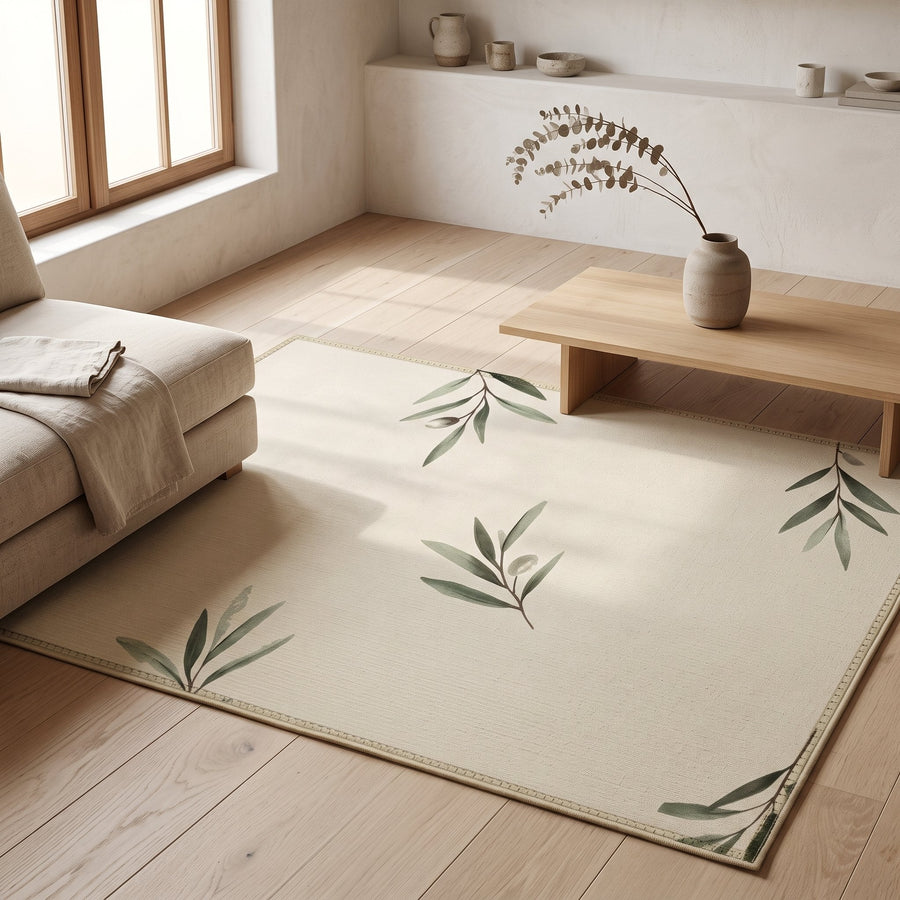
A large rug is the single most effective addition. It absorbs footsteps and chair noise and stops the floor reflecting voices. Choose a rug big enough for both chairs to stay on it when pulled back from the desks; for most setups that means extending around 60 to 75 cm beyond the desk edge. Low-pile or flatweave rugs let chairs roll more easily. Our rug sizing guide has measurements for common room shapes.
Curtains
Windows are hard, reflective surfaces. Full-length curtains in a heavy fabric soften them considerably, and blackout curtains add a useful layer of insulation. Hang them wide and high, so they cover the wall around the window as well as the glass.
Upholstery and books
A small upholstered chair or a cushion-lined bench gives the room more soft surface and a place to step away from the desk. Filled bookshelves also break up sound, because uneven surfaces scatter it rather than reflect it. Even a wall hanging or a large fabric print behind the caller's desk helps on video calls.
Making a Japandi office for two work every day
The layout and palette set the stage; habits keep it calm. Agree on a few simple rules. Desks are cleared at the end of each day. Calls go to the softer zone, or to another room if they are long. Shared storage, such as a closed cabinet or a set of boxes, holds anything not used daily.
A Japandi office for two is not about perfect symmetry or identical desks. It is about two people sharing a room that feels like it was designed for both of them, with enough order, softness and quiet to let each person do good work. For more on what to put behind closed doors, our guide to Japandi office storage is a good next step.
Worth considering
A few well-made pieces we would happily put next to our own. These are Amazon links; as an Amazon Associate we earn from qualifying purchases, at no cost to you.
- Slim solid white-oak writing desk, 38" — Two of these give each person a matching desk in one wood; at 38 inches it suits back-to-back or zoned layouts better than side by side.
- Furnimart linen-beige task chair — A neutral upholstered chair that two people can share a palette around.
- CADUKE plug-in linen-shade swing-arm sconces — Plug-in sconces, one above each desk, with no rewiring.
Frequently asked questions
How big does a room need to be for two desks?
Two people can share a room of around 9 to 10 square metres with desks side by side along one wall. Facing or back-to-back layouts usually need a little more, roughly three metres of width, to leave space for chairs. Measure chair clearance as well as desk size.
How do you reduce echo in a shared home office?
Add soft surfaces. A large rug under both desks, full-length curtains, an upholstered chair and filled bookshelves all absorb or scatter sound. Placing the person who takes the most calls in the softest corner helps most.
Should two people in one office have matching desks?
Matching desks make a room look calmer, but they are not essential. If your desks differ, unify them with the same wood tone, the same lamp, the same chair and a shared accent colour. Consistent small details do most of the work.