Japandi office storage follows one principle: closed and low for everything you need but do not want to look at, and one open shelf for the few things worth seeing. Paper, cables, chargers and files go behind doors below waist height. Wood, a single ceramic, a print and perhaps a plant go on the one shelf that stays open. This guide walks through the three parts of that system, which pieces to buy, and the cable discipline that holds it together.
The principle: hide the paper, show the wood
An office generates a specific kind of clutter. It is not decorative and it is not chosen; it is paper that arrived, cables that came with something, and small plastic objects that are useful once a month. None of it belongs in view, and no amount of clever arrangement will make a stack of envelopes look calm.
So the Japandi answer is not to style the clutter but to remove it from the picture. Closed storage takes the paper. What remains visible is the material of the storage itself, ideally the same wood as the desk, and a small number of objects placed with intent. The effect is a room that looks as though it holds very little, while actually holding everything you need. Our longer piece on storage that does not look like storage sets out the same idea for the whole house.
Closed and low: the workhorse
The main storage piece in a Japandi office is a low cabinet or sideboard, usually no higher than the desk, with doors rather than open cubbies. Keeping it low does two things. It leaves the wall above free, so the room keeps its horizon and its air, and it puts the top of the cabinet at a height where a single object on it reads as a display rather than a shelf of things.
Look for these qualities when choosing it.
- Plain doors, no visible handles. Push-to-open doors or a finger groove along the top edge keep the front of the cabinet as a single plane of wood. Handles, however handsome, are the first thing the eye catches.
- Legs, or a recessed plinth. A cabinet that floats a few centimetres off the floor looks lighter than one that sits flat on it, and it lets a rug run underneath.
- Adjustable shelves inside. Printers, box files and a router are all different heights. Fixed shelves force you to store things in the wrong place.
- The same wood as the desk, or a quiet contrast. Oak with oak, walnut with walnut. If you want a second material, a painted door in a warm off-white or a soft grey sits well beside either, as long as the frame stays wooden.
Inside, keep it simple: paper in one place, cables in one lidded box, stationery in a shallow tray. If the cabinet is full within a month, you have too much paper, not too little storage.
The desk drawer, if there is one
A single shallow drawer under the desk is enough for pens, a notebook and the charger you use daily. Deeper drawers accumulate. If the desk has none, a slim wooden box with a lid, kept to one side of the surface, does the same job and can be lifted away when you want the desk clear. Our guide to the Japandi executive desk covers drawers and pedestals on larger desks.
One open shelf: the exhibition
With the working clutter behind doors, the room can afford one open shelf, and only one. It might be a single floating plank above the cabinet, a length of oak on brackets, or the top surface of the cabinet itself. Its job is not storage; it is the place where the room shows what it values.
Apply the same discipline here as on the desk. Three to five objects, spaced generously, with a mix of heights and a single palette of materials. A short row of books with their spines turned to a neutral tone, one ceramic, one small framed print leaning rather than hung, a branch in water. Leave at least a third of the shelf empty. The six-object rule applies to a shelf as well as a surface.
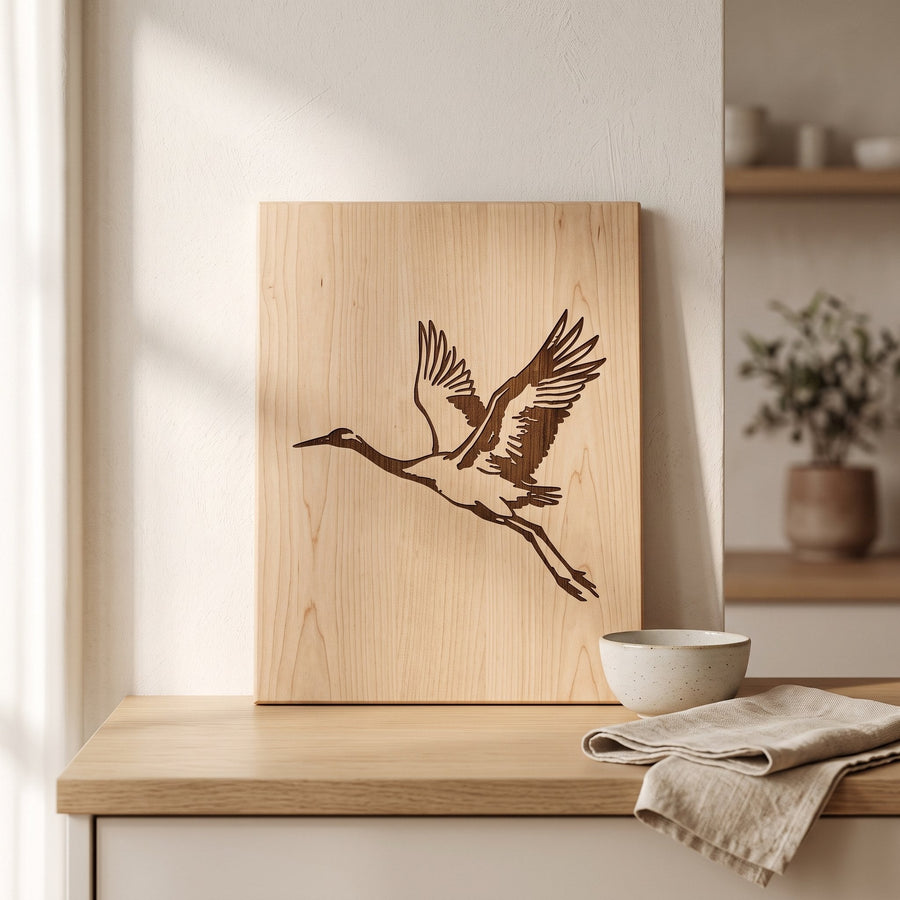
A wooden board leaning against the wall on that shelf is a trick we use often. It gives the arrangement a backdrop, hides an outlet or a patch of wall, and adds a broad plane of grain at eye level without hanging anything.
Cable discipline
Cables are the part of office storage that undoes the rest. A perfect cabinet next to a desk with a black tangle beneath it is still a messy room. Treat cables as a storage problem with its own rules.
- One cable to the wall. A power strip screwed to the underside of the desk takes every plug. A single lead runs from it to the socket, ideally down a desk leg or behind the cabinet.
- Everything with a home. A cable tray under the rear edge holds the strip and the slack. Nothing hangs.
- The router lives in the cabinet. Drill a small hole in the back panel if needed. Routers and their lights do not belong on a shelf.
- Short cables, matched colours. Replace long cables with ones just long enough, in white on a pale desk and black on a dark one.
- Spares in a box, not a drawer. The cables you might need one day go in a lidded box in the cabinet. If you have not opened it in a year, most of them can go.
If you are setting up from scratch, our twelve-point desk setup checklist puts cable routing before anything decorative, which is the only order that works.
Storage in a small office
In a small room, or an office that shares space with a bedroom or living room, the low cabinet may be all the storage there is, and the open shelf may be the top of it. That is enough. Resist the tall bookcase; it eats the wall and turns a corner into an office. A slim cabinet the width of the desk, with the one shelf above, keeps the footprint honest. Our guide to the small Japandi office works through the layouts.
Vertical space can still be used, but sparingly: a single wall-mounted rail with two or three wooden clips for the papers you are actually working on, or a shallow wall box with a door. Nothing above head height.
What the room should look like when you are done
Standing at the door, you should see a desk, a low run of wood beside or behind it, one shelf with a few things on it, and floor. No paper, no cables, no plastic. The office will still hold every file and charger it did before; it simply will not show them.
That is the whole of Japandi office storage: put the working life behind a plain wooden door, give yourself one shelf for the things that deserve the light, and keep the cables as invisible as the paper. The room will feel larger, and the work will feel lighter.
Worth considering
A few well-made pieces we would happily put next to our own. These are Amazon links; as an Amazon Associate we earn from qualifying purchases, at no cost to you.
- Smuxee walnut fluted sideboard storage cabinet — Closed and low: paper and chargers behind doors, with a top that can serve as the one open shelf.
- Trademark lidded seagrass storage boxes, set of 2 — Lidded boxes for the overflow that will not fit in the cabinet, in a material worth seeing.
- Bamboo expandable drawer dividers, set of 4 — Order inside the drawers, so the closed storage stays usable rather than becoming a second desk.
- Under-desk cable management tray (no-drill) — The cable discipline part of the system, fixed under the desk without drilling.
Frequently asked questions
What storage works best in a minimalist home office?
A low, closed cabinet in the same wood as the desk for paper, cables and equipment, plus one open shelf for a few chosen objects. Keep the cabinet below desk height so the wall stays clear, and choose doors without visible handles so the front reads as a single plane.
How do I hide a printer in a Japandi office?
Put it inside the low cabinet on an adjustable shelf, with a hole drilled in the back panel for its cable. A printer on a shelf or the floor is the most common thing that breaks a calm office. If it must stay out, choose a white or matt black one and keep it on the cabinet top with nothing else beside it.
Should a home office have open shelves?
One, at most. Open shelving invites paper and small objects, and a wall of it turns the room into a storeroom. A single floating shelf, or the top of a low cabinet, holding three to five objects with space between them, gives the room a place to show wood and ceramic without inviting clutter.