Japandi coffee table styling comes down to three objects: a tray, a vessel and a book. The tray gathers, the vessel gives height, the book gives a flat, quiet plane. Everything else is either on the tray or off the table. This guide explains why three is the number, how to choose each object, how to vary their heights, and how to leave enough empty surface that the table still feels like a table.
Why three objects
A coffee table is the one surface in a living room that everybody uses. Cups land on it, feet rest near it, and books drift across it. Styling it heavily fights that use, and the table ends up either crowded or constantly being tidied.
Three objects is the number that reads as considered without becoming a display. It is also odd, which the eye finds more natural than pairs, and it leaves the majority of the surface empty. That emptiness is not a gap waiting to be filled. In Japanese design it has a name, ma, and it is doing as much work as the objects are. Our piece on the art of negative space explains the idea; our six-object rule applies it to a whole room.
Object one: the tray
The tray is the most important of the three, because it turns clutter into composition. A remote control, a box of matches and a candle on a bare table look like three things somebody left there. The same items on a wooden tray look like a decision.
Choose a tray with a low lip in a warm wood, such as oak, ash or walnut, or in a matte black lacquer for a darker room. Round trays suit a rectangular table and soften its corners; rectangular trays suit a round or oval table for the same reason in reverse. Size it to about a third of the table's surface, so it sits comfortably at one end or one side rather than in the centre.
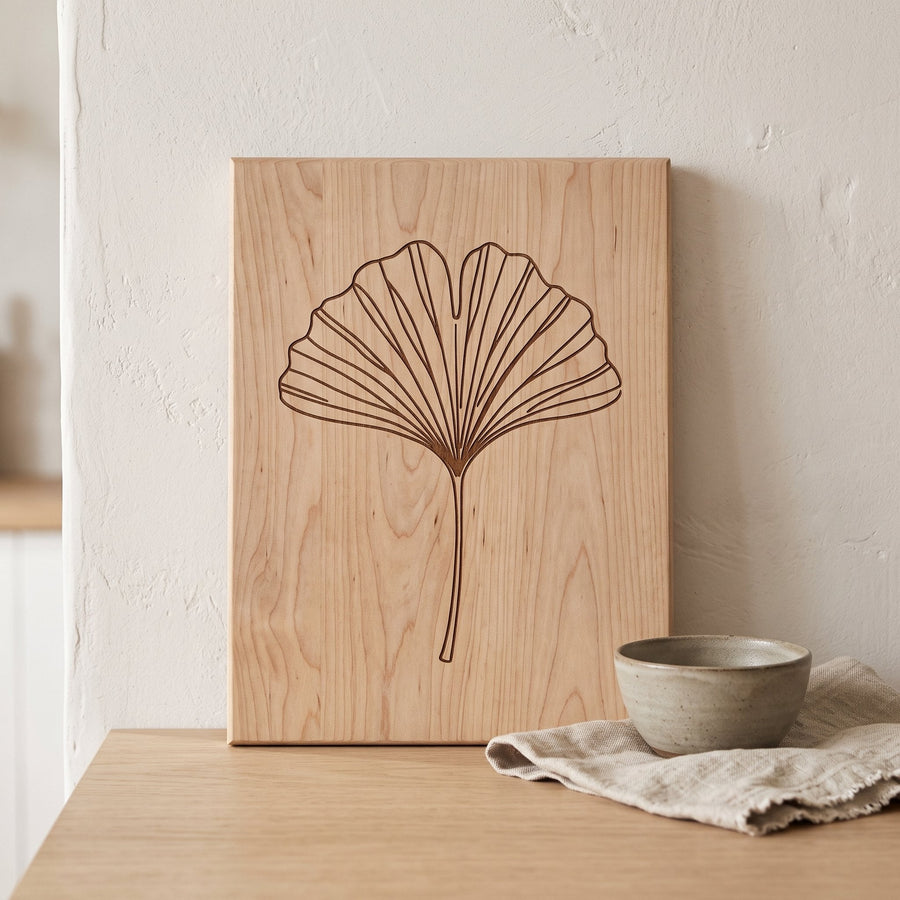
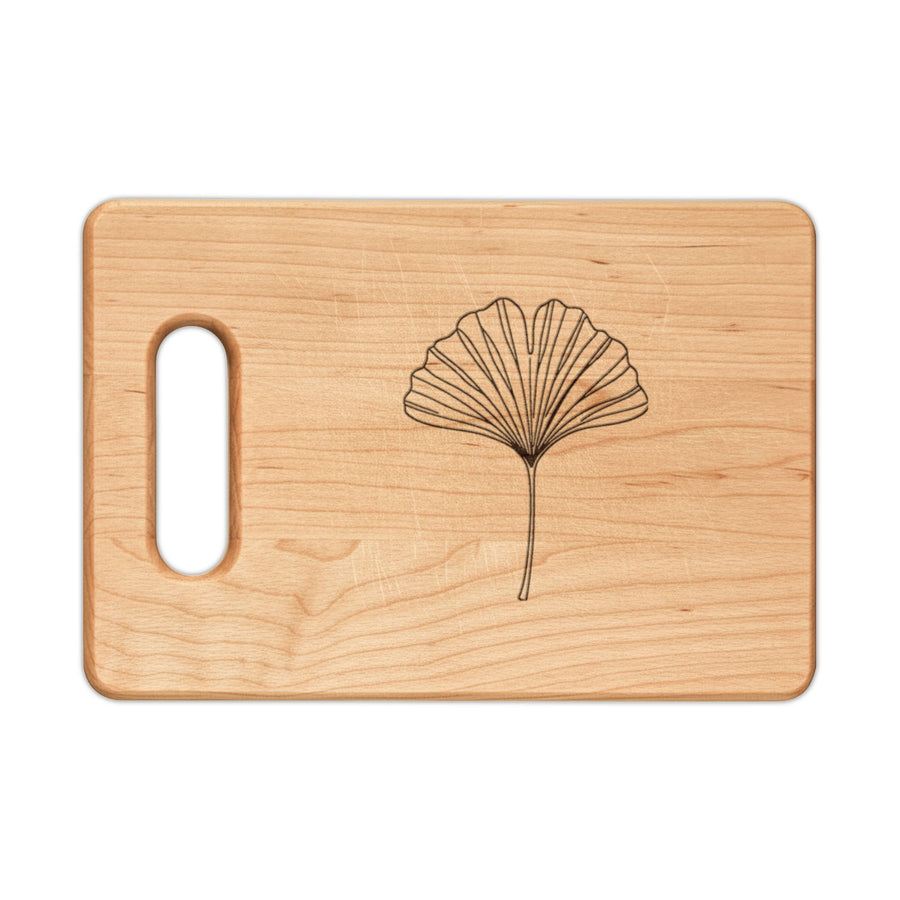
An engraved wooden serving board does the same job with a little more character, and it can go back to the kitchen when you have guests. We wrote about the tray as a household tool in why your kitchen needs a tray, and the same logic holds in the living room.
What goes on the tray
Two or three small things, at most. A candle in a stoneware or glass vessel. A small dish for matches or keys. A ceramic cup you like the look of. The remote, if it must live there. The tray gives these things a boundary, and the boundary is what keeps them from spreading.
Object two: the vessel
The vessel provides the tallest point on the table and the one piece of life. A vase with a single stem or branch is the classic choice, and it should be the tallest thing on the table by a clear margin. A stoneware jug, a small bowl of fruit, or a lidded ceramic pot can stand in when there is nothing in the garden.
Keep the vessel to one, and keep what goes in it to one as well. A single stem of eucalyptus, a dried seed head, a branch of blossom in spring, a bare twig in winter. The single-stem rule is our shorthand for this, and it is the fastest way to make a table look intentional.
Place the vessel on the table itself, not on the tray, and diagonally opposite the tray's position. That puts the two heaviest visual elements at opposite corners and leaves the middle open.
Object three: the book
The book is the flat, horizontal counterweight to the vessel's height. One large hardback, or a short stack of two or three, with the spines facing the sofa so you can read them. Choose by cover as much as by content; a plain cloth binding in a muted colour does more for the table than a glossy dust jacket.
The stack should be low. Two books are fine, three is the limit. Anything taller starts to look like storage. A small object can rest on top of the stack, such as a stone, a ceramic coaster or a pair of reading glasses, but it is optional and often better left off.
Heights and the triangle
The three objects should sit at three different heights: tall, medium and low. The vessel is tall. The tray with its candle is medium. The book is low. Seen from the sofa, the tops of the three describe a soft triangle, and that shape is what makes the arrangement feel balanced rather than lined up.
A quick check is to sit down and look at the table at eye level. If two things are the same height, lower one or raise the other. A small stack of books under the vessel, or a lower candle on the tray, is usually enough.
Keep the objects towards the edges and corners of the table. The centre stays clear for cups, feet and whatever arrives on a Friday evening. A useful proportion is objects covering no more than about 40 percent of the surface, with the remaining 60 percent left as bare wood or stone.
Materials that belong together
The Japandi coffee table itself is usually oak, ash, walnut or a pale stone, low and simple. Our guide to the Japandi sofa covers how table height relates to the seat.
On it, mix no more than three materials: wood, ceramic and paper, say, or stone, glass and linen. If the table is wood, the tray can be wood too, as long as the tone is a little different, or it can be ceramic or black lacquer for contrast. Avoid anything shiny. The point is a small, quiet family of textures that the hand wants to touch, which is the same principle we set out in honest materials.
Changing it with the seasons
The pleasure of the three-object approach is that changing one object changes the whole table. Swap the stem in the vessel for the season: blossom in spring, a green branch in summer, seed heads in autumn, a bare twig in winter. Change the candle vessel from clear glass to stoneware as the evenings draw in. Trade the book for the one you are reading.
Nothing else needs to move. The tray stays, the book stack stays roughly where it was, and the table looks fresh four times a year for the cost of a walk in the garden. Our guide to wabi-sabi shelf styling applies the same rhythm to the shelves above.
Three things, and then stop
Japandi coffee table styling is less about what you add than about what you decline to add. A tray, a vessel, a book, arranged at three heights and pushed to the edges, and the table is finished. The moment a fourth thing appears, ask whether it belongs on the tray, on a shelf, or in a drawer.
Usually the answer is a drawer. Then sit down, put your feet up, and use the table for what it is for.
Worth considering
A few well-made pieces we would happily put next to our own. These are Amazon links; as an Amazon Associate we earn from qualifying purchases, at no cost to you.
- Acacia-wood tray with cut-out handles, 17″ — Object one: a plain wooden tray that gathers the small things and lifts off when the table is needed.
- Brown ceramic centrepiece vase — Object two: a heavy, earthy vessel that gives the arrangement its height.
- Round coffee table, 27.6″ — A small round table that holds three objects and still leaves most of its surface bare.
Frequently asked questions
What should I put on a Japandi coffee table?
Three things: a wooden or ceramic tray holding a candle and one or two small items, a vessel with a single stem, and a low stack of one to three books. Arrange them at three different heights, towards the edges of the table, and leave most of the surface clear.
How do you style a round coffee table?
Use a rectangular or square tray to contrast with the curve, and place it slightly off-centre. Put the vessel on the opposite side and the book stack between them, so the three objects form a loose triangle. Keep the centre of the table open for cups.
Should a coffee table match the sofa?
No, but the two should sit at a similar height, with the tabletop level with or a few centimetres below the seat cushion. Contrast is good: a pale oak table against a charcoal sofa, or a dark stained table against oatmeal linen. Match the table's wood tone to something else in the room instead, such as a shelf or a picture frame.