The best Japandi office plants are sculptural, slow-growing and hard to kill: a ZZ plant, a snake plant and a rubber plant cover almost every desk and light level. Each has a strong, simple shape that reads like an object rather than a jungle, and each will forgive a missed watering during a busy week. Choose one, give it a good pot, and let it stand on its own.
This guide explains what makes a plant suit a Japandi workspace, how to look after each of the three, how to choose the right pot, and what to do if you would rather have no living plant at all.
What makes a plant feel Japandi
Japandi is a style of restraint. Objects are chosen for their form, materials are honest, and there is generous empty space around everything. A plant in that setting needs to behave like one of those objects. Three qualities matter.
A clear silhouette. Upright leaves, a single trunk or a strong repeated shape. Trailing plants and dense, fluffy foliage can look lovely elsewhere, but on a minimal desk they read as clutter.
Slow change. A plant that doubles in size each summer will soon outgrow its spot. Slow growers keep their proportions for years, which suits a room where everything has its place.
Low maintenance. An office plant competes with deadlines. If it needs daily misting or exact light, it will suffer, and a struggling plant is not a calm sight. Choose something that tolerates neglect.
These ideas echo our guide to the single-stem rule: one living thing, given space, says more than many crowded together.
The three Japandi office plants we recommend
1. ZZ plant (Zamioculcas zamiifolia)
The ZZ plant grows in upright stems lined with glossy, dark green leaves arranged like a ladder. The shape is architectural and tidy, and it rarely sprawls. It stores water in its thick roots, so it copes with being forgotten for two or three weeks at a time.
It tolerates low light better than most houseplants, which makes it a strong choice for an office corner or a desk away from the window. Water only when the soil is completely dry, and err on the side of less. Overwatering is the most common way to lose one.
2. Snake plant (Dracaena trifasciata)
Still widely sold under its old name, Sansevieria, the snake plant grows in stiff, upright blades that look almost carved. A single pot of tall blades makes a strong vertical line beside a desk or bookshelf, and smaller varieties sit comfortably on a windowsill.
It is one of the most forgiving plants you can buy. It handles low or bright light, dry air and infrequent watering. In winter, it may need water only once a month. Choose a variety with plain green or softly banded leaves; the bright yellow-edged forms are less calm.
3. Rubber plant (Ficus elastica)
If you have room for a floor plant, the rubber plant gives you a single woody stem with large, rounded, dark leaves. It has the presence of a small tree without the fussiness of a fiddle-leaf fig, and the leaves have a soft sheen that suits oak and linen.
It prefers bright, indirect light, so place it a metre or two from a window rather than in a dark corner. Wipe the leaves occasionally to keep them clean, and turn the pot every few weeks so it grows evenly. Pinching out the top encourages a fuller shape if it becomes leggy.
One practical note: all three plants are considered mildly toxic if chewed, so place them out of reach if you share your office with a curious cat or dog.
Choosing the right pot
In a Japandi office the pot matters as much as the plant. It is the part you see most, and the wrong pot can undo the calm of a well-chosen plant.
- Material. Unglazed terracotta, matte stoneware, concrete and woven fibre all suit the style. Avoid glossy, brightly coloured or patterned ceramics, which pull attention from the plant.
- Colour. Choose from the room's existing palette: warm white, sand, clay or charcoal. A dark pot gives a light plant definition; a pale pot lets a dark plant stand out.
- Shape. Simple cylinders and low, wide bowls work best. Tapered pots can look top-heavy with tall plants like snake plants.
- Drainage. Keep the plant in a plastic nursery pot with drainage holes and set that inside a decorative cache-pot. You can lift it out to water at the sink and avoid standing water at the roots.
- Size. A pot slightly larger than you think looks more grounded. Leave a little space between pot and wall so the plant has room to breathe visually.
For desks, a small saucer of cork or wood protects the surface and adds a natural material. Our guide to Japandi desk accessories covers how to keep a work surface clear while still giving it a few chosen objects.
Where to place a plant in a home office
Placement decides whether a plant feels intentional or incidental. As a starting point, put it to one side of your desk, not in the centre. A plant directly in front of you blocks your line of sight to the screen and the room beyond; one to the side sits in your peripheral vision, where its calm is most useful.
If you take video calls, consider what sits behind you. A single tall snake plant or rubber plant against a plain wall gives a backdrop depth without distraction. Avoid placing it directly behind your head, where it will appear to grow from your shoulders.
Think about light too. Plants that receive light from one side lean towards it. A quarter turn every couple of weeks keeps them upright, which matters for sculptural plants where the shape is the point. Our broader Japandi home office guide shows how a plant fits into a full workspace layout, and the Japandi desk setup checklist covers everything else on the desk.
The single-stem alternative
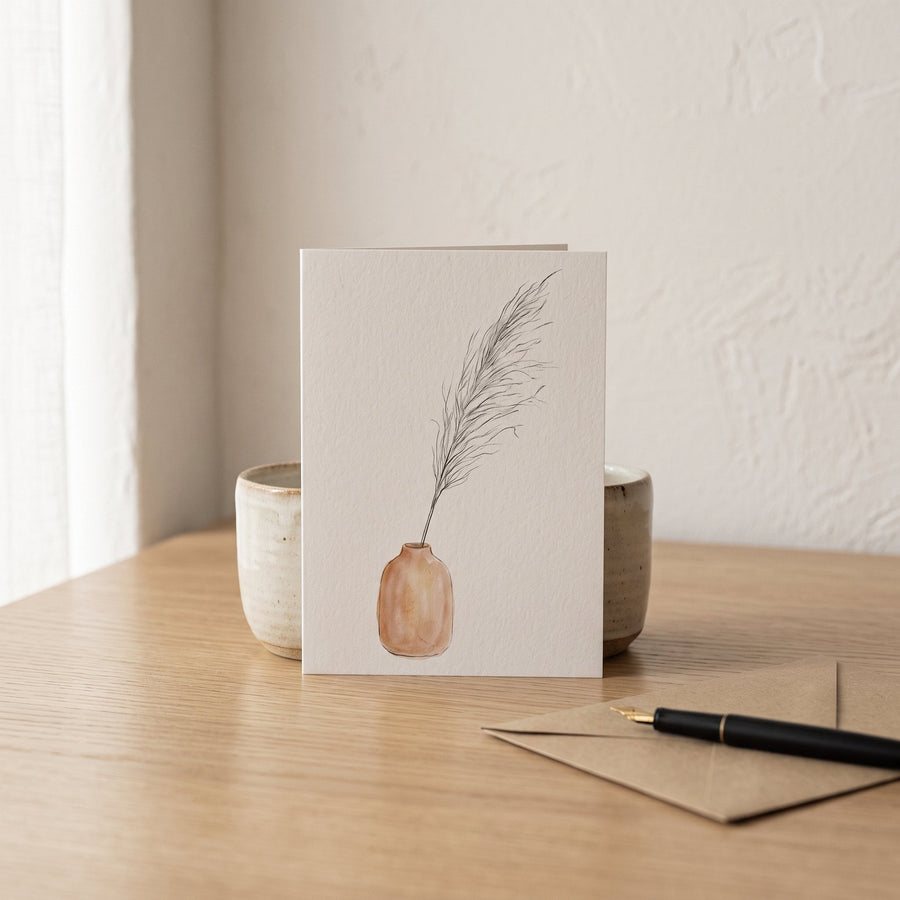
Not everyone wants to care for a plant, and some offices simply lack the light. A single cut stem in a narrow vase is a beautiful alternative, and one that sits closer to the Japanese tradition of ikebana than any potted plant.
Woody branches last longest. A stem of eucalyptus, beech, olive or flowering cherry in water can last one to several weeks depending on the stem and the room. Dried stems, such as pampas, grasses or a seed head, last for months. Choose a vase that is heavier than the stem, so it does not tip, and keep only one thing in it. The emptiness around a single stem is what gives it its weight.
You can also rotate. A branch in spring, a leafy stem in summer, something dried in winter. It is a small ritual that marks the season without adding anything to look after.
Choosing your Japandi office plants
A Japandi workspace does not need many plants. It needs the right one, in the right pot, given room. A ZZ plant for a dim corner, a snake plant for a strong vertical line, or a rubber plant for a floor-standing presence will each bring life to an office without adding work.
If even that feels like too much, a single stem will do the same job. The aim is not greenery for its own sake but one quiet living thing that makes the hours at your desk feel a little gentler.
Worth considering
A few well-made pieces we would happily put next to our own. These are Amazon links; as an Amazon Associate we earn from qualifying purchases, at no cost to you.
- Ceramic planter set of 3 — A set of three ceramic pots, for a ZZ plant or a small snake plant on the desk.
- Creative Co-Op large matte white embossed stoneware planter — A larger stoneware pot for a rubber plant on the floor, matt rather than glossy.
- Cream ribbed bud vase set — For the single-stem alternative: one branch in water instead of a plant to look after.
Frequently asked questions
What is the best low-light plant for a home office?
The ZZ plant is the most reliable choice for low light, followed closely by the snake plant. Both tolerate rooms away from windows and need watering only when the soil is fully dry. Neither will grow quickly in low light, which suits a tidy workspace.
How many plants should a Japandi office have?
One or two is usually right. A single sculptural plant beside the desk, perhaps with a cut stem on a shelf, keeps the space calm. More than that tends to turn a minimal office into a plant collection.
Are fake plants acceptable in a Japandi room?
Japandi values honest materials, so artificial plants sit uneasily with the style. Dried stems, branches in water or a hardy living plant feel more in keeping and are not much more effort. If you need something maintenance-free, choose dried over plastic.