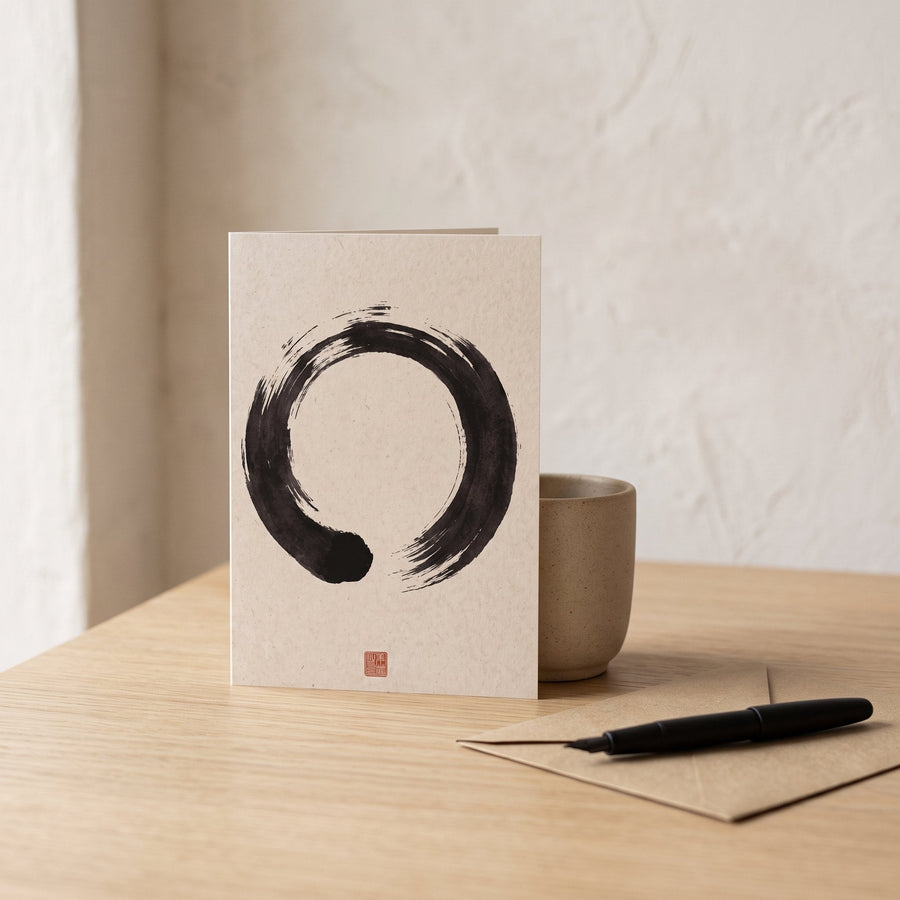
For most Japandi walls, a framed paper print is the better choice: the mount, the thin wooden frame and the flat surface suit a style built on calm lines and visible materials. Canvas wins in a few specific situations, such as very large pieces, rooms with awkward glare, or bold painterly images that look better without glass. This guide to canvas vs framed print compares depth, glare, cost and overall look, so you can decide wall by wall.
Canvas vs framed print: how each looks on the wall
A canvas print is stretched over a wooden frame, usually two to four centimetres deep, and hung without glass. It sits forward from the wall as a solid block, and the image often wraps around the sides. The effect is closer to a painting: soft surface, no reflections, a definite physical presence.
A framed print is flat paper held behind glass or acrylic, usually with a mount, inside a slim frame. It reads as quieter and more considered. The mount gives the image breathing room, and the frame draws a clean line between art and wall. In a room that values negative space, that border does a lot of work.
Why Japandi rooms tend to favour frames
Japandi is a style of honest materials and restrained edges. A frame in pale oak, ash or a dark stained wood repeats the timber in the furniture, which ties the art into the room. A wide white or off-white mount echoes plaster walls and paper lampshades. Canvas, with its wrapped edges and slightly glossy surface coatings, can look a little heavier than the rest of a pared-back room.
Depth and presence
Depth is canvas's strongest argument. A deep canvas casts a shadow on the wall and reads clearly from across a large room, which can be useful on a long, empty wall or in a double-height space. It has the bulk to balance a big sofa or a long sideboard.
Framed prints get their presence differently: through scale and margin rather than thickness. A 50 × 70 cm print in a wide mount and a 2 cm frame can hold a wall just as well as a canvas, but it does so quietly. If you want the art to anchor the room without dominating it, the frame is usually right.
Glare, light and placement
Glass reflects. If a print hangs opposite a window, the view of the window can sit on top of the image for much of the day. This is where canvas genuinely wins: with no glazing, it reads the same under any light.
There are other fixes before you give up on a frame, though:
- Use anti-reflective glazing. It costs more than standard glass, but it removes most reflections and makes a framed print look almost unglazed.
- Change the angle. Moving a print to a side wall, or tilting it very slightly with a deeper bottom spacer, often removes the worst glare.
- Change the lighting. A lamp placed to the side rather than directly in front reduces hotspots. Our guide to Japandi lighting covers lamp placement in more detail.
Bathrooms and kitchens deserve a separate mention. Steam and splashes are hard on both, but a sealed frame with acrylic glazing usually fares better than an unprotected canvas, which can absorb moisture and grease.
Cost and flexibility
At small and medium sizes, a print plus a ready-made frame is often similar in cost to a canvas of the same size, and sometimes cheaper. At large sizes, canvas can be more economical because there is no large sheet of glass to make, ship and handle.
Frames win on flexibility. When you tire of an image, you can swap the print and keep the frame. You can move a print from a 30 × 40 cm frame into a larger one with a wider mount. You can rotate artwork with the seasons. A canvas is fixed: the image and the object are the same thing. If you like to change your walls, paper in a good frame is the more sustainable habit. Our guide on how to frame art prints explains how to choose a frame that will outlast several prints.
When canvas wins
There are honest reasons to choose canvas, even in a Japandi home:
- Very large pieces. Above roughly 100 cm on the long side, glazed frames become heavy and expensive. A large canvas is lighter and easier to hang.
- Unavoidable glare. If the only good wall faces a large window and anti-reflective glass is out of budget, canvas removes the problem completely.
- Painterly or textured images. Some abstract work, especially images with brush texture and strong colour, benefits from the canvas weave and from being seen without glass.
- Children's rooms and busy hallways. No glass means nothing to break if a ball or a bag hits the wall.
When you do choose canvas, keep it calm: a narrower depth, a white or neutral edge rather than a wrapped image, and a muted palette. A thin wooden floater frame around a canvas can also bridge the two looks, giving the edge definition without glass.
When a framed print is the better choice
Choose paper in a frame for ink drawings, line work, soft watercolour washes and anything with a lot of empty space. These images depend on the quality of the white and the crispness of the mark, and glass protects both. Frames also suit small and medium pieces, groupings and gallery walls, where consistent frames make a set of different images feel like one composition. Our sibling guide to the Japandi gallery wall shows how to plan spacing and frame colour.
The choice of paper matters too. Fine-art paper adds warmth and texture; smooth matte stays crisp and graphic. Our comparison of matte vs fine-art paper explains which suits which kind of image.
Making the call for your walls
In the canvas vs framed print question, there is no single right answer, only the right answer for each wall. For the calm, layered look most people want from a Japandi room, a paper print with a generous mount and a slim wooden frame is the reliable choice. It is flexible, it protects the artwork, and it repeats the honest materials found elsewhere in the room.
Keep canvas for the walls that need it: the very large, the very bright, and the places where glass would be a risk. Used deliberately, both can live in the same home, and the room will feel more considered for it.
Frequently asked questions
Is canvas or framed art more expensive?
At small and medium sizes the costs are often similar, especially with ready-made frames. At large sizes canvas is usually cheaper, because large glazed frames are heavy and costly to make and ship. Custom framing with museum glass costs more than either.
Do canvas prints look cheap?
Not inherently, but a thin, glossy canvas with a wrapped image can look less refined than a framed print. A quality canvas with a matte finish, neutral edges and a modest depth looks considered, especially at large sizes.
What frame colour suits a Japandi room?
Natural oak, ash or a soft walnut usually works best, ideally matching or gently contrasting the dominant wood in the room. Black frames suit ink drawings and darker rooms. Keep all frames in one grouping the same finish for a calm result.